SC Urges AR Rahman To Acknowledge Dagar Tradition In The Veera Raja Veera Case
The Supreme Court urged A.R. Rahman to acknowledge the Dagarvani tradition’s contribution to “Veera Raja Veera” from Ponniyin Selvan II, amid a copyright dispute with Ustad Faiyaz Wasifuddin Dagar. While leaving questions of authorship open, the Court sustained a ₹2 crore deposit order and stressed recognition beyond legal niceties.

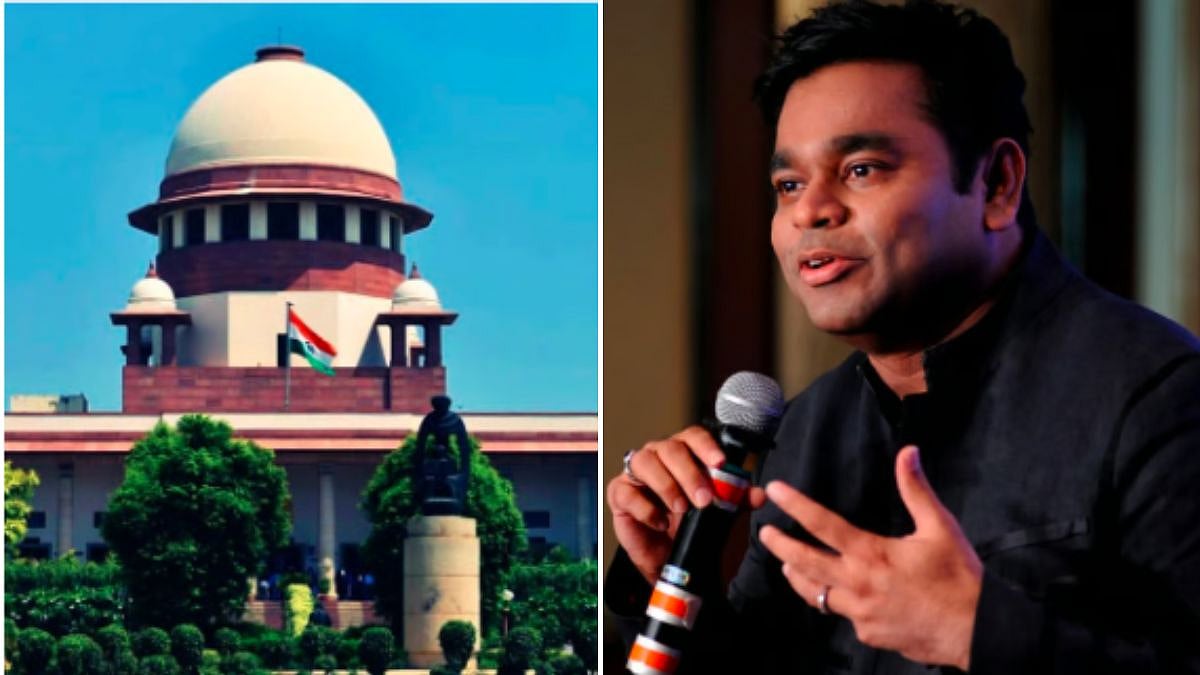
The Supreme Court on Friday urged music composer A.R. Rahman to acknowledge the contribution of the Dagarvani tradition to the song “Veera Raja Veera” from the film Ponniyin Selvan II, saying there should be “some acknowledgement” of Dhrupad vocalist Ustad Faiyaz Wasifuddin Dagar and his predecessors. | File Pic
The Supreme Court on Friday urged music composer A.R. Rahman to acknowledge the contribution of the Dagarvani tradition to the song “Veera Raja Veera” from the film Ponniyin Selvan II, saying there should be “some acknowledgement” of Dhrupad vocalist Ustad Faiyaz Wasifuddin Dagar and his predecessors.
A Bench comprising Chief Justice of India Surya Kant and Justice Joymalya Bagchi was hearing Dagar’s appeal against a September 2025 order of a Division Bench of the Delhi High Court that had set aside an interim injunction granted earlier in his copyright dispute over the song.
A Push for Recognition Over Legal Combat
The Bench made it clear that beyond the legal battle, there was a larger issue of recognition. Justice Bagchi noted that Rahman had already acknowledged the Dagarvani tradition in his presentation slides and suggested that the acknowledgement could go a step further by mentioning that the composition was first performed by Dagar’s forebears.
“Instead of going into the legal niceties… at least this can be done,” Justice Bagchi told Senior Advocate Abhishek Manu Singhvi, who appeared for Rahman. Chief Justice Kant remarked pointedly, “If these gharanas would not have contributed to the shastriya sangeet, do you think these modern singers would have managed?”
Justice Bagchi added that the Dagar family was not competing in the commercial space but seeking “respect and recognition.” Singhvi responded that he understood the Court’s “subtext” and would take instructions on adding a line acknowledging the first performance, without prejudice to Rahman’s legal stand.
The Court adjourned the matter to February 20.
Deposit Order Sustained, Originality Question Open
Importantly, the Supreme Court sustained the single judge’s direction requiring Rahman to deposit ₹2 crore with the Registrar General of the Delhi High Court pending disposal of the suit.
During the hearing, the Bench observed that Dagar had made out a case on originality, though authorship would need detailed examination. “In originality, you have made out a case, and on authorship, we will examine. First performance does not necessarily mean authorship,” the Court said, noting that independent evidence would be required to establish that the composition did not predate the Dagar tradition’s rendition.
Dagar claims that “Veera Raja Veera” infringes the Dhrupad composition “Shiva Stuti”, which he says was composed in the 1970s by his father, the late Ustad Faiyazuddin Dagar, and his uncle, the late Ustad Zahiruddin Dagar, collectively known as the Junior Dagar Brothers.
According to Dagar, the composition was first publicly recorded during a performance at the Royal Tropical Institute in Amsterdam on June 22, 1978, and later commercially released through PAN Records. He alleges that protectable portions of “Shiva Stuti”, including its core melodic structure, swara patterns, rhythm cycle and emotional expression, were incorporated into Rahman’s song without authorisation.
He further claims that copyright and moral rights devolved upon him after a family settlement following the demise of the original composers. He has also alleged that two of his disciples, who later participated in the recording of “Veera Raja Veera”, shared the composition with Rahman without consent.
Rahman has denied the allegations, arguing that “Shiva Stuti” is a traditional Dhrupad composition in the public domain and that “Veera Raja Veera” is an original work composed using Western musical fundamentals with 227 distinct layers.
In April 2025, a single judge of the Delhi High Court found a prima facie case of copyright infringement, directed that credits be shared with the late Junior Dagar Brothers, and ordered the deposit of ₹2 crore as security. However, in September 2025, a Division Bench set aside the interim injunction, holding that Dagar had not established a sufficient prima facie case of authorship or originality and that the composition drew from the broader Dhrupad and Dagarvani tradition.
Challenging that decision, Dagar argued before the Supreme Court that the Division Bench exceeded the permissible scope of appellate scrutiny. He contended that Indian copyright law does not require musical works to be reduced to written notation and that fixation through sound recordings is valid proof of authorship. The 1978 Amsterdam performance and its commercial release, he said, amounted to legal fixation.
He also challenged the High Court’s interpretation of Section 55(2) of the Copyright Act, arguing that it creates only a rebuttable presumption of authorship and does not defeat a claim merely because the author’s name does not appear on a publication.
During the hearing, Justice Bagchi framed the central issue: whether Dagar was the creator or whether the composition flowed from the Dagar tradition. When Dagar’s counsel clarified that he was not claiming originality of the raga but of the composition, the Bench noted the distinction between the structure of the raga and the specific arrangement in sur thal.
The case now stands at an important crossroads. While the legal questions of authorship and originality remain to be settled, the Supreme Court’s remarks reflect a deeper concern that India’s classical traditions must not be sidelined in modern adaptations. In a dispute that straddles law and legacy, the Court’s message is clear: recognition may not end the lawsuit, but it can restore dignity to tradition.
RECENT STORIES
-
-
-
-
-