Marco Rubio In India: US Secretary Of State Faces A Monumental Task To Repair New Delhi-Washington Ties
US Secretary of State Marco Rubio faces a high-stakes diplomatic rescue mission as he arrived for a four-city India tour aimed at resolving sharp bilateral fractures over the ongoing Middle East energy crisis, punitive trade tariffs and regional security

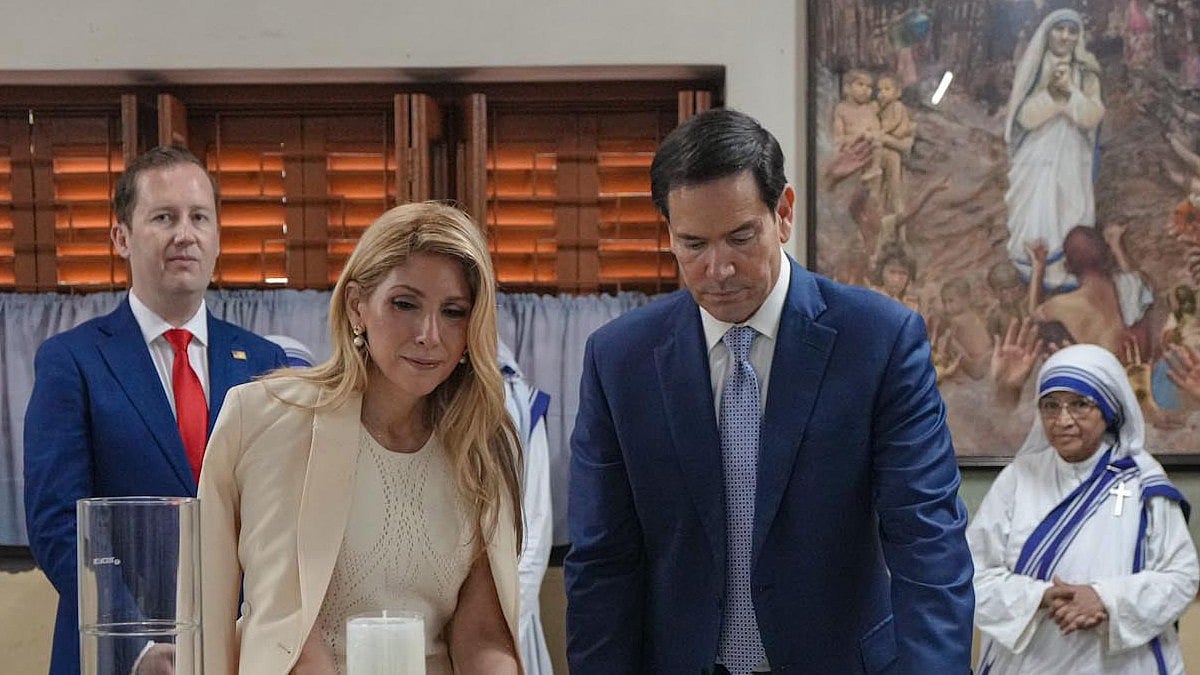
US Secretary of State Marco Rubio visited the Missionaries of Charity today to pay homage to the legacy of Mother Teressa | @SecRubio
When US Secretary of State Marco Rubio wheeled up from Kolkata for New Delhi on Saturday after visiting The Mother Teresa House Of The Missionaries Of Charity, his visit to India has actually started then. Rubio definitely has his work cut out for him as the diplomatic reality behind closed doors is bound to be heavy, transactional and intensely calculated. Apart from Kolkata, his itinerary features Agra and Jaipur before heading to New Delhi.
The bilateral relationship between India and the United States has felt distinctly rudderless over the last year strained by sudden tariff hikes and volatile shifts in Washington's foreign policy. Rubio is essentially on a high-stakes rescue mission to stabilise ties and his checklist covers several massive friction points.
Strait of Hormuz effect
First on the agenda is navigating a severe energy crisis. With the ongoing naval blockade and conflict in the Middle East choking the Strait of Hormuz, India’s energy security is under immense pressure. Rising crude prices and disrupted supply lines have forced New Delhi to look for alternatives, but Washington’s intense pressure over India’s reliance on sanctioned Russian oil has long been a major point of friction.
Rubio is arriving with a clear pitch to Buy American, explicitly noting before his trip that the US is producing energy at historic levels and wants to sell India as much as it can take. He has even floated a Venezuelan oil gambit, suggesting the US wants to facilitate the flow of Venezuelan crude to India to offset Middle Eastern supply shocks, while simultaneously pushing commercial nuclear energy partnerships to help India hit its long-term clean energy goals.
Re-stitching a frayed trade deal
Re-stitching a frayed trade deal will be another uphill battle. Bilateral trade is currently affected by deep scars, particularly after the administration previously hit India with steep tariffs, including a punitive 25 per cent levy targeting New Delhi's procurement of Russian oil.
While US Ambassador to India Sergio Gor has optimistically leaked that a major bilateral trade agreement is finally in its legal language phase and nearing a signature, Rubio still has to manage deep structural wariness. India is acutely aware of how quickly immediate commercial calculations in Washington can override long-term strategic alignments.
Resuscitating the Quad
On May 26, Rubio will transition to multilateral diplomacy when he sits down with his counterparts from India, Japan and Australia for a crucial Quad Foreign Ministers' Meeting. For Washington, the Quad is a critical instrument to balance China's expanding footprint in the Indo-Pacific and secure supply chains for sensitive tech like semiconductors.
However, Rubio’s big challenge is accepting the reality of India’s strict multi-alignment policy. Just days before hosting the Quad, New Delhi chaired the BRICS foreign ministers' discussions, engaging comfortably with Russia, China and Iran. Because India views the Quad as a flexible partnership for maritime security and technology rather than a formal military alliance, Rubio must balance hard geopolitical demands with respect for India's strategic autonomy.
Pakistan angle
Finally, the Secretary of State will have to handle a tough crowd regarding regional security and dipping public perception. Rubio will likely face a very blunt, unified front from Delhi's foreign policy establishment regarding Washington's recent diplomatic overtures to Pakistan, specifically the high-profile treatment of Pakistan's Army Chief, General Asim Munir.
Deepening the divide
To truly understand why Rubio's task is so monumental, one must look at the structural divergence that has quietly formed between Washington and New Delhi over the last 12 months. For a long time, the India-US partnership was heralded as an "indispensable alliance of the 21st century," built on the shared democratic values and a mutual desire to check China's revisionist ambitions in Asia.
However, the transactional nature of the current Washington administration has tested the limits of this alignment.
The core of the issue lies in a fundamental mismatch of expectations. Washington frequently treats its security partners as pieces on a global chessboard, expecting them to fall in line with its sanctions regimes and geopolitical priorities. India, conversely, operates under the doctrine of strategic autonomy.
Cultural diplomacy gambit
Recognising these deep structural tensions, Rubio's itinerary has been deliberately designed to blend heavy geopolitical bargaining with soft-power cultural diplomacy. His first stop in Kolkata—specifically visiting the Missionaries of Charity's Mother House—was a highly calculated opening move. By visiting the tomb of Mother Teresa as his very first official act on Indian soil, Rubio managed to quietly signal reassurance to domestic audiences back home without delivering an overt, public lecture that would alienate his Indian hosts.
Building the strategic core
While energy and trade will dominate the immediate headlines, the long-term survival of the India-US partnership will likely be decided in the less glamorous arena of supply chain resilience and advanced technology. During the upcoming ministerial meetings, Rubio is expected to push hard for concrete progress on non-Chinese supply chains, particularly regarding semiconductors and critical minerals. With India recently aligning itself with the US-led Pax Silica framework, Washington is eager to transition from theoretical cooperation to actual, boots-on-the-ground manufacturing hubs.
This is where the Quad meeting on May 26 becomes critical. The alliance is trying to position itself as a viable alternative to China’s dominance over rare earth elements and critical minerals—such as lithium and cobalt—which are essential for everything from smartphone batteries to advanced fighter jets. India offers massive geological potential and a desperate hunger to scale up its domestic manufacturing capabilities.
If Rubio can offer India tangible American investment and technology transfers rather than just empty promises of strategic partnership, he might find a much more receptive audience in New Delhi.
RECENT STORIES
-
-
-
-
-