ISRO, European Space Agency Renew Partnership Till 2032, Widen Focus To Space Weather And Exploration
The ISRO-ESA partnership has expanded from Earth observation to human and robotic exploration under a renewed agreement lasting until 2032. Signed in Paris, the pact covers areas including space weather, sustainability and advanced technologies. ESA and ISRO said the collaboration builds on decades of cooperation involving mission support, scientific studies, technology sharing and data exchange.

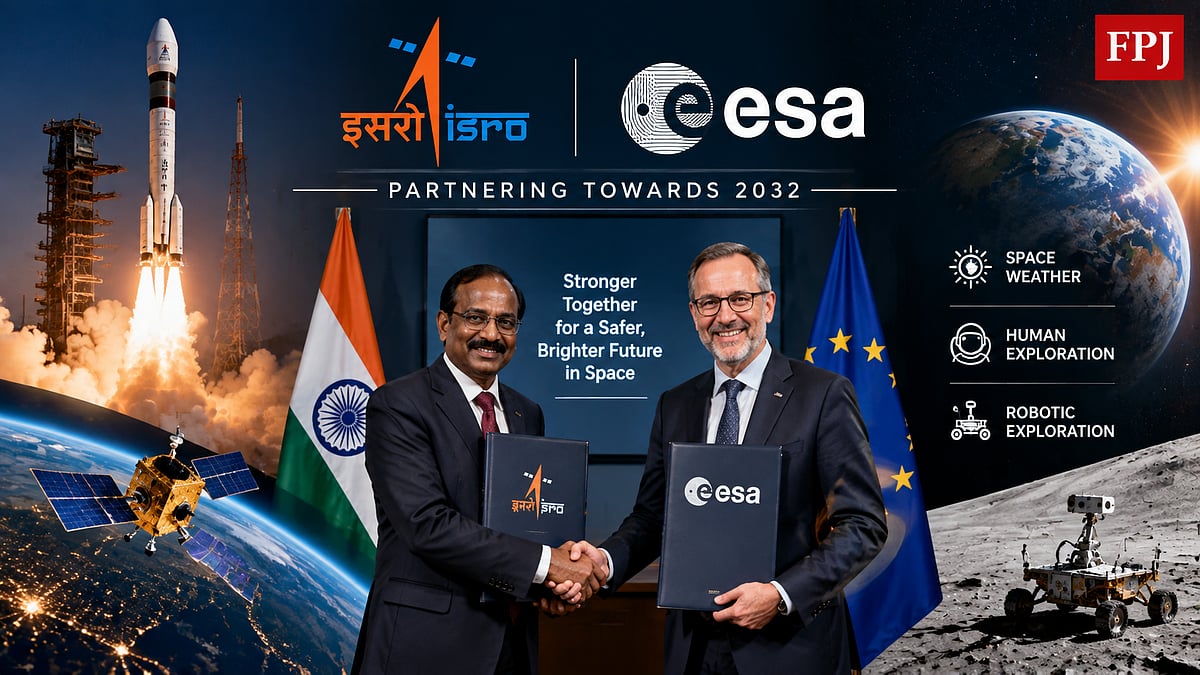
ISRO, European Space Agency Renew Partnership Till 2032, Widen Focus To Space Weather And Exploration | AI
The Indian Space Research Organisation (ISRO) and the European Space Agency (ESA) have renewed their long-standing cooperation agreement till 2032, expanding their partnership into areas such as space weather and human and robotic exploration.
The agreement was signed by ISRO Chairman V Narayanan and ESA Director General Josef Aschbacher during the International Space Summit held in Paris on September 9 and 10. The renewed pact reaffirms the commitment of India and Europe to deepen cooperation in space and build on a partnership that has developed over several decades.
From satellites to deeper space
The latest agreement widens the scope of cooperation at a time when space agencies are looking beyond conventional satellite missions towards human exploration, robotic missions and the sustainable use of outer space. Space weather will also be an important part of the collaboration.
Changes in space weather can affect satellites and, in turn, communication systems, navigation services and power grids on Earth. Cooperation in this field could therefore have practical benefits beyond scientific research, making the expanded partnership particularly relevant as countries become increasingly dependent on space-based infrastructure.
The two agencies have already worked together on missions including Aditya-L1 and Proba-3 and are expected to cooperate on the upcoming Chandrayaan-5 mission.
Aschbacher said the renewed agreement would allow the agencies to pursue “greater ambitions together while delivering tangible benefits for our citizens and economies”, Indian Express reports.
“As space activities expand beyond Earth orbit and new opportunities emerge in exploration, sustainability and advanced technologies, international cooperation remains essential. ESA and ISRO have built a trusted partnership spanning more than two decades,” he said in a statement on Monday.
Human exploration enters the picture
Narayanan said the partnership had demonstrated the importance of international cooperation in advancing space activities.
“The renewal of this agreement reflects the shared ambition of ISRO and ESA to pursue innovation and scientific progress for the benefit of our societies,” he said.
The expansion into human and robotic exploration is significant as human spaceflight programmes gather momentum. India is planning a series of robotic missions, including Gaganyaan-1, which is scheduled sometime before March 2027 and will carry Vyommitra, a female humanoid, into space.
The two agencies had taken another step towards cooperation in human exploration in May 2025, when they signed a Joint Statement of Intent during the Global Space Exploration Conference in New Delhi. Both sides are yet to have their indigenous human space exploration programmes. Indian Gaganyatris have also received training at some ESA centres in recent years.
A partnership dating back to 1978
ISRO and ESA cooperation dates to 1978, when their engagement initially focused on Earth observation and remote sensing. It included data sharing, ground stations, tracking and scientific validation for monitoring land, oceans, weather and disasters, according to an ISRO officer involved in the joint engagements.
The relationship broadened after the two agencies signed a Cooperative Agreement in January 2002. The agreement established a framework for cooperation across a wide range of space activities. Since then, ESA and ISRO have supported each other in areas including mission tracking, expert reviews and scientific collaboration.
The partnership has continued to evolve. In March 2026, the agencies signed another agreement covering joint calibration and scientific studies, allowing them to share technology, data and infrastructure with the aim of making space missions more reliable and affordable.
Why the renewed pact matters
The extension till 2032 shows how the ISRO-ESA relationship has moved from a largely technical partnership in Earth observation to cooperation in some of the most important emerging areas of space activity.
The emphasis on space weather, sustainability and human and robotic exploration also reflects the changing priorities of space programmes. As missions become more complex and move farther beyond Earth orbit, sharing scientific expertise, infrastructure and technology can help agencies pursue projects that would otherwise demand greater resources individually.
For India and Europe, the renewed agreement provides continuity to a partnership that began nearly five decades ago while giving it a wider role in the next phase of space exploration.
RECENT STORIES
-
-
-
-
-