India’s Undertrial Crisis: 73 Per Cent Of Prisoners Await Trial As Bail Barriers And Delays Keep Them Behind Bars
Nearly 73% of India’s 5,11,542 prisoners are undertrials, highlighting a justice crisis where prolonged detention, bail conditions and delayed trials can keep people behind bars without conviction. Supreme Court rulings and legal safeguards seek to protect liberty, but weak implementation continues to fuel overcrowding and unequal access to bail.

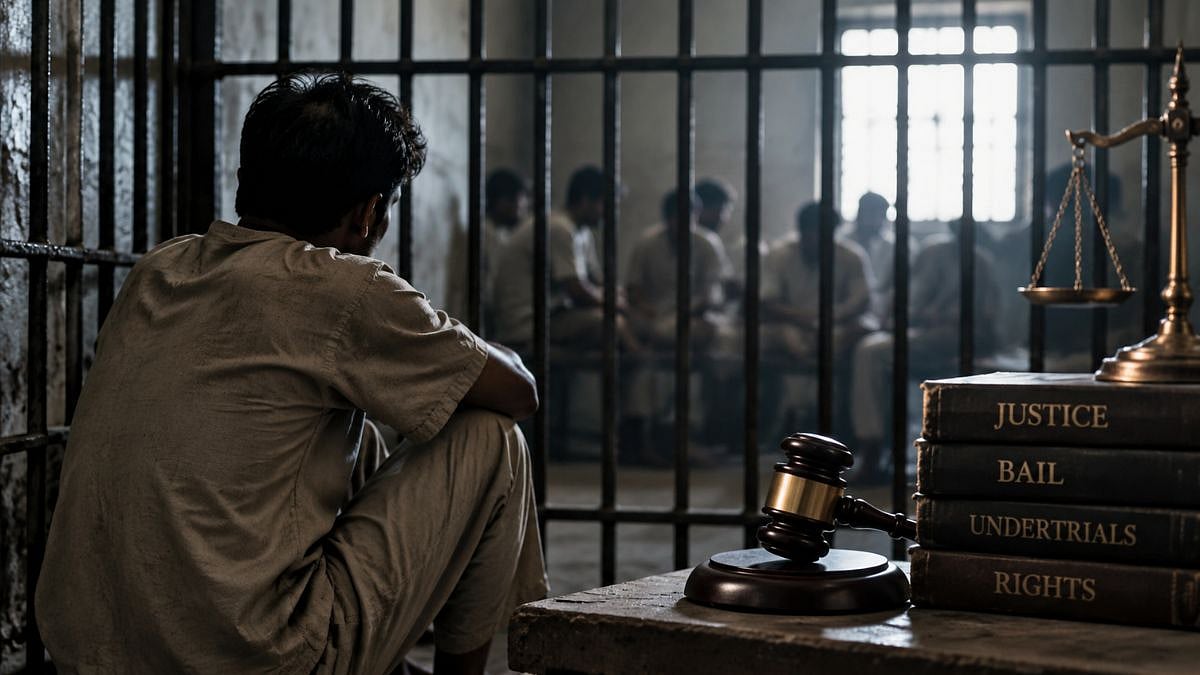
Nearly three in four prisoners in India are awaiting trial without a conviction, highlighting persistent concerns over bail and delayed justice | AI Generated Representational Image
New Delhi, September 5, 2026: India’s courts have repeatedly stressed a basic principle of criminal justice: bail is the rule and jail is the exception. Yet for thousands of people caught in the criminal justice system, imprisonment begins well before a court decides whether they are guilty. For some, that question may remain unanswered for years.
The latest National Crime Records Bureau (NCRB) Prison Statistics India report shows the scale of the problem. India’s national prison occupancy has fallen to 112.7%, but overcrowding is only one part of the story. Of the 5,11,542 people in Indian jails, 72.6% have not been convicted. In effect, nearly three in every four prisoners are undertrials.
The Numbers Tell A Grim Story
The national average also hides severe overcrowding in several states and Union Territories. Delhi has the highest occupancy rate at 194.6%, with undertrials accounting for more than 87% of its prison population. Meghalaya follows at 163.5%, while Jammu and Kashmir stands at 148.3%, Madhya Pradesh at 147.1% and Maharashtra at 143.9%.
These numbers raise an uncomfortable question. If imprisonment before conviction is supposed to be an exception, why does it appear so routine? Pre-trial detention can become punishment in practice when people remain behind bars simply because they cannot secure bail or meet financial conditions attached to their release.
Young And Disadvantaged Bear The Brunt
The profile of India’s prison population makes the crisis more troubling. About 86.3% of prisoners are between 18 and 50 years old. Nearly 68% are either illiterate, at 26.2%, or have not studied beyond Class 10, at 41.6%.
There is also a clear social dimension. Scheduled Castes account for 21.8% of prisoners, Scheduled Tribes 14.1% and Other Backward Classes 33.2%. Together, these communities make up close to 69% of the prison population. The figures suggest that the burden of incarceration falls heavily on sections of society that have historically faced social and economic disadvantages, TNIE reports.
Strong Laws, Weak Enforcement
India does not lack legal safeguards against unnecessary arrests and detention. The larger problem appears to be their implementation.
In Arnesh Kumar v. State of Bihar (2014), a Supreme Court Bench of Justices Chandramauli Kr Prasad and Pinaki Chandra Ghose addressed the problem of mechanical arrests and routine judicial remands in offences punishable by up to seven years in prison.
The Court made it clear that merely having the power to arrest does not justify using it routinely. Detention must remain an exceptional measure under Article 21.
“The existence of the power to arrest is one thing, the justification for the exercise of it is quite another... The attitude to arrest first and then proceed with the rest is despicable,” the Court observed.
The safeguards were rooted in Section 41(1)(b) of the Code of Criminal Procedure (CrPC), now Section 35 of the Bharatiya Nagarik Suraksha Sanhita (BNSS). Police cannot arrest a person simply because a complaint has been made. Officers must record why an arrest is necessary, including to prevent further crime, ensure proper investigation, prevent evidence tampering or witness intimidation, or ensure attendance before a court.
Where custody is unnecessary, Section 41A of the CrPC provides for a notice of appearance, allowing a person to participate in the investigation without being arrested.
A Battle That Began Decades Ago
The fight against prolonged undertrial detention is hardly new. Hussainara Khatoon & Ors. v. Home Secretary, State of Bihar (1979) became one of India’s earliest and most consequential public interest cases.
After investigative reports by KF Rustamji appeared in a national daily, advocate Pushpa Kapila Hingorani filed what became India’s first reported public interest litigation. The case exposed the plight of more than 40,000 undertrials in Bihar’s prisons, including facilities in Patna, Muzaffarpur and Ranchi, many of whom had remained incarcerated for periods longer than the maximum sentences they could have received.
Among them was Hussainara Khatoon, who had spent more than four years in “protective custody” without a trial.
A Supreme Court Bench led by Justice PN Bhagwati recognised speedy trial and free legal aid as fundamental rights protected by Article 21. Justice Bhagwati also criticised a system in which a person’s financial position could determine whether liberty was available.
The Court directed that indigent people be released on personal recognisance bonds without requiring monetary sureties or property titles. More than four decades later, however, the persistence of the undertrial problem shows how difficult it has been to translate that constitutional principle into everyday practice.
Bail Should Not Depend On Money
The Supreme Court returned to the problem in Satender Kumar Antil v. CBI (2022), confronting the continued tendency of subordinate courts to default to custody.
The Court divided offences into four categories, A through D, to provide greater clarity on bail. For Category A offences, carrying sentences of seven years or less, it said bail should generally be granted without first requiring custody. Notices of appearance should also be the norm rather than the exception.
The Court addressed another practical barrier: money. If a person is granted bail but cannot arrange the required sureties or financial security within seven days, the trial court must act on its own to consider converting those conditions into a personal bond.
The judges also called on Parliament to consider a dedicated Bail Act, along the lines of the UK’s Bail Act, 1976. Such a law could reduce inconsistency and make liberty less dependent on the discretion of individual courts.
The principle is difficult to dispute: bail should assess whether releasing a person poses a genuine risk, not whether that person has enough money or property to secure freedom.
Half The Sentence Without A Conviction
Section 436A of the CrPC, now carried forward and expanded through Section 479 of the BNSS, provides another safeguard against excessive undertrial detention.
A person facing an offence other than one punishable by death or life imprisonment must be released on a personal bond after spending half of the maximum possible sentence in detention during investigation, inquiry or trial. Under the BNSS provision, first-time offenders receive greater protection and can qualify for release after serving one-third of the maximum period.
The rule is simple on paper. Making sure eligible prisoners actually benefit from it has proved more difficult.
In Bhim Singh v. Union of India (2014), the Supreme Court issued time-bound directions to address precisely this failure. A Bench led by then Chief Justice RM Lodha directed Judicial Magistrates, Sessions Judges and Chief Judicial Magistrates to conduct weekly jail-visit court sessions from Oct 1, 2014.
The judicial officers were expected to enter prisons, identify undertrials eligible for release and issue orders on the spot. High Courts were tasked with monitoring compliance every quarter.
India Can Look Beyond Its Borders
Other countries have experimented with ways to reduce dependence on pre-trial incarceration. In the United States, several jurisdictions have moved towards algorithmic risk assessments rather than relying solely on cash bail. The approach seeks to prevent poverty itself from becoming a reason for detention while taking public safety into account.
European countries have used community supervision and administrative fines for minor offences to keep petty cases from unnecessarily adding to prison populations.
Uganda has adopted another model through “ChainLinked Committees”, which bring police, magistrates and prison officials together to review pending cases. The idea is to break administrative silos that can leave cases unattended for years.
India does not necessarily need to copy any one system. But these examples underline an important point: incarceration need not be the automatic response when less restrictive alternatives can achieve the purpose of the law.
Liberty Cannot Remain A Paper Promise
India already has court judgments, statutory safeguards and mechanisms such as Under-Trial Review Committees. What appears to be missing is consistent implementation.
A meaningful solution would require reducing the dependence of bail on monetary sureties, strengthening the enforcement role of Under-Trial Review Committees and making the release provisions under Section 479 of the BNSS work automatically for eligible prisoners.
Risk should determine whether someone needs to remain in custody, not the size of their bank balance. When nearly 73% of prisoners have not been convicted, the undertrial crisis cannot be treated merely as a prison-management problem. It is also a question of liberty, equality and access to justice.
Also Watch:
ALSO READ
Article 21 promises protection of life and personal liberty. But that promise loses much of its meaning when people who have not been found guilty remain imprisoned because procedures move slowly or freedom comes with financial conditions they cannot meet.
India’s prison crisis, therefore, is not only about overcrowded cells. It is about whether the principle that bail is the rule and jail the exception survives beyond the pages of judgments.
To get details on exclusive and budget-friendly property deals in Mumbai & surrounding regions, do visit: https://budgetproperties.in/
RECENT STORIES
-
-
-
-
-