Delhi Court Sets Aside Order Refusing FIR Against Sonia Gandhi, Directs Fresh Hearing
The Delhi sessions court set aside a magistrate’s order refusing an FIR plea against Sonia Gandhi over allegations about her electoral roll entry before citizenship, and sent the complaint for fresh consideration. The court directed the magistrate to hear the complainant and police officer and conduct an inquiry. It said the earlier order lacked adequate reasoning.

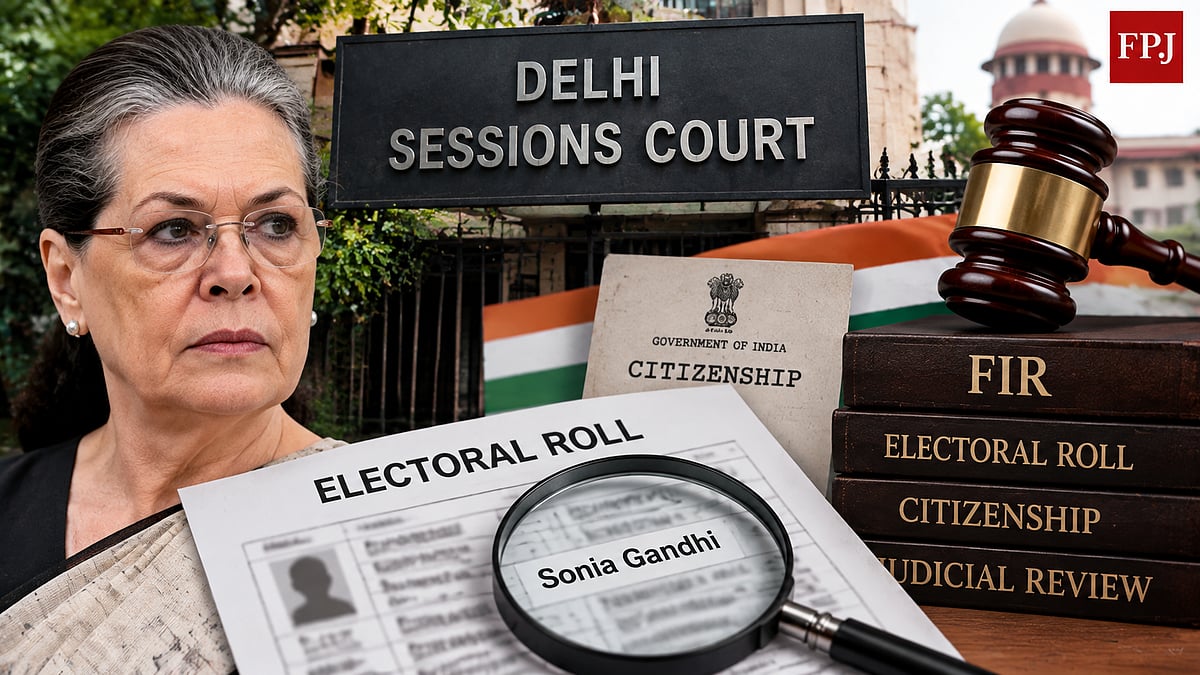
Delhi Court Sets Aside Order Refusing FIR Against Sonia Gandhi, Directs Fresh Hearing | AI
A Delhi sessions court on Monday set aside a magistrate’s order refusing to direct the registration of an FIR against Congress leader Sonia Gandhi over allegations that her name was included in the electoral roll before she acquired Indian citizenship.
Special Judge Vishal Gogne directed the magistrate to consider the complaint afresh and pass a reasoned order after hearing complainant Vikas Tripathi and the police officer concerned and conducting an inquiry. The matter will be listed before the Additional Chief Judicial Magistrate (ACJM) on September 29, Live Law and Bar & Bench report.
Court Finds Gaps In Earlier Order
The sessions court found that the magistrate’s order was a “non-speaking order” that lacked adequate reasons. It said there was no proper discussion on whether the allegations in the complaint disclosed a cognisable offence.
The court observed that any allegation involving tampering with an electoral roll, fraudulent inclusion of a voter or non-citizen, or false declarations required a reasoned examination, particularly when allegations of cheating and forgery had been raised.
Judge Gogne also found that the earlier order did not adequately examine the sequence in which Gandhi’s name was allegedly included, deleted and subsequently included again in the electoral rolls in 1980, 1982 and 1983.
The sessions court said the order suffered from a “manifest error in law” because the submissions of the police officer concerned were not heard and a status report was not called for from the police station.
The court also found the magistrate’s reasoning regarding the Central Government’s powers over citizenship and the Election Commission of India’s powers concerning electoral rolls to be improper.
Importantly, the sessions court did not order the registration of an FIR itself. It said a revisional court could not assume the role of a judicial magistrate and decide whether an FIR should be registered under Section 175(3) of the Bharatiya Nagarik Suraksha Sanhita (BNSS). That exercise, it said, must be carried out by the magistrate.
What The Complaint Alleges
Tripathi’s complaint alleges that Gandhi’s name appeared on the electoral roll of the New Delhi constituency in 1980, although she became an Indian citizen only in April 1983.
According to Tripathi, Gandhi’s name was included in the electoral roll in 1980, deleted in 1982 and included again in 1983. He has alleged that forged documents were used to secure the inclusion and sought the registration of an FIR against her.
The allegations remain unproven, and the sessions court’s order does not amount to a finding that Gandhi committed forgery, cheating or any other offence. The immediate legal issue is whether the complaint warrants further action under the law.
Gandhi Rejects Allegations
Gandhi has denied the allegations and described the case as “wholly misconceived, frivolous, politically motivated, and an abuse of the process of law”.
In her reply before the court, she argued that the complaint was based on speculative assumptions, media reports and “imaginary applications” and did not contain foundational documents supporting the allegations.
Her reply also contended that Tripathi had not produced copies of the alleged voter registration applications, citizenship-related documents or purported forged records. It further argued that he had not demonstrated any attempt to obtain such documents through lawful means.
How The Case Reached Sessions Court
The complaint was initially dismissed on September 11, 2025, by Additional Chief Judicial Magistrate Vaibhav Chaurasiya.
The magistrate had held that the court could not encroach upon the jurisdiction of the Election Commission of India by entertaining the plea seeking an FIR against Gandhi. The court had also found that assertions unsupported by essential particulars could not constitute a legally sustainable allegation of cheating or forgery.
The magistrate had noted that Tripathi relied on an extract of the electoral roll that was a photocopy of an alleged uncertified electoral roll from 1980.
ALSO READ
Tripathi subsequently challenged that decision through a criminal revision petition. The revisional court issued notice to Gandhi on December 9, 2025.
Fresh Hearing Now
By setting aside the magistrate’s order, the sessions court has effectively sent the dispute back for a fresh examination rather than deciding the allegations itself.
The distinction is significant: the order does not direct the police to register an FIR against Gandhi and does not determine the truth of the allegations. It requires the magistrate to examine the complaint, hear the relevant parties and police, conduct the required inquiry and give clear reasons for the eventual decision.
The case will now return to the ACJM court on September 29, when the process of reconsidering Tripathi’s complaint is set to begin.
RECENT STORIES
-
-
-
-
-