Does India Have A Problem With Vulgar Lyrics?
Is the outrage against vulgar lyrics justified? And is there a limit which shouldn't be crossed? Let's find out.

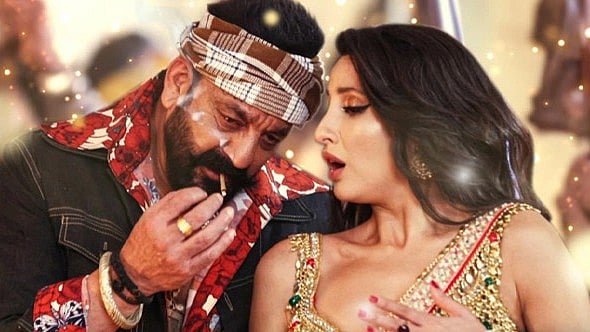
A still from Sarke Chunar Teri Sarke | IMDb
Suggestive lyrics have always been a part of Bollywood songs, with probably the ‘iconic’ place for such reserved by Choli Ke Peechei Kya Hai from Khalnayak (1993) to the notorious Sarkay Leo Khattiya Jaada Lage (Raja Babu,1994), both of which caused quite the furore when they were released.
A month back, however, the ‘suggestive’ part of the lyrics was literally done away with, and we were handed a straightforward description of the ‘act’ via Nora Fatehi’s item number Sarke Chunar Teri Sarke from the upcoming film KD: The Devil. The song also starred Sanjay Dutt, who interestingly was also part of Choli Ke Peechei Kya Hai. The vulgarity of the song was criticised heavily on social media. However, reportedly, in this case, Dutt maintains that he was completely unaware about the lyrics and would not have been part of the song if he knew about them.
This controversy coincides with Badshah’s song Tateeree facing a backlash, owing to the fact that it had girls dressed in school uniforms dancing to the song in a classroom-like environment named ‘Badshala’, along with suggestive lyrics. These cases had FIRs, protests, and the National Commission for Women stepping in, post which various clarifications have been issued from both sides. While the lyricist of ‘Sarkei’ said that he merely translates the lyrics from Kannada, Nora said that she wasn’t aware of the use of such lyrics. Badshah has apologised and pledged to sponsor the education of 50 girls from underprivileged backgrounds.
But the main point here is whether Bollywood is a playground for vulgar lyrics. Hasn’t this always been the case? Are the protests louder now due to social media? We spoke to several eminent lyricists to hear their thoughts on the issue.
Responsible writing needs accountability
I believe in freedom of speech, however, songs are separate from other pieces of art. You can reach other forms of art, but a song is that art form which reaches you. On the other hand, whether or not you read a book or see a movie is up to you, but songs can reach you anywhere, like when you are walking on the road or attending a marriage. Which is why there is no way in which you can keep it away from yourself or your children. This is why I feel writing songs is something that carries a lot of responsibility, and I do not agree with such lyrics in songs; in fact, I vehemently oppose it. Divy Nidhi Sharma, screenwriter, dialogue writer, and lyricist.
(Divy has been part of films and series such as Sitaare Zameen Par, Laapataa Ladies, Heeramandi, Freedom at Midnight, Anupamaa, and Yeh Rishta Kya Kehlata Hai. His latest project is Chiraiya.)
Audience divide shapes song trends
India does have a problem with vulgar lyrics because I do see this prevalent in Bhojpuri music, which is very focused on objectifying women and double-meaning songs. The videos, choreography, and lyrics are absolutely crass, but it works in a particular belt out there, with people appreciating it. So there are two kinds of audiences in India: one is the very sanskari and modern audience, where they find things very cheesy and cheap or whatever, while the other ones find this absolutely palatable. And that’s the reason why also there is an entire market of item songs, the kinds which are probably played at clubs or even dance bars.
That’s the reason why these kinds of songs are made, or they even see the light of day, because there is an audience for it. The producer also puts money behind them because he knows that these kinds of songs will probably fly. Nobody would make a song if it’s not going to work.
As far as artistic freedom being trampled upon is concerned, I would say that it is being taken for granted, in the sense that just because you’re an artist, you can land up writing anything. Now that’s not the case; it’s very subjective. Like if you see in the West as well, a lot of rap songs, for example WAP by Cardi B, are fun to listen to in a club, but it’s material that is not suitable for kids and is extremely adult-oriented. A lot of popular rap and some pop songs are also extremely sexualised in the West.
In terms of Badshah and Nora Fatehi’s song, I think it’s not necessarily an individual artist who needs to be blamed, penalising them and making them a scapegoat, but as a whole, the industry and the entire country must put a regulation on this.
Thomson Andrews, playback singer and composer.
(Thomson has been in Bollywood for the past 18 years, having worked with everyone from A R Rahman to Pritam.)
Balance between creativity responsibility
India has always had a wide spectrum of lyrical expression, from timeless poetry to playful and suggestive writing. What has changed today is not the presence of such content, but its amplification through social media, where every lyric is instantly dissected, often without context. As creators, we must acknowledge that words carry influence and reach audiences across generations, making responsibility an important part of the craft.
At the same time, creativity cannot exist under fear or constant policing. The real conversation is not about restricting expression, but about encouraging discernment within the industry. There is a fine line between clever writing and excess, and that balance must come from creative integrity rather than imposed censorship. The way forward lies in respecting audience sensitivities while preserving the authenticity and freedom that define artistic expression.
Sameer Anjaan, lyricist and Managing Partner, Aumora Music.
Sameer has been associated with films such as Saajan (1991), Damini (1993), Bhool Bhulaiya 3 (2024).
ALSO READ
The Hall of Fame
Rukumani Rukumani from Roja (1992):
‘Rukumani Rukumani Shaadi Ke Baad Kya Kya Hua?’ from A R Rahman’s Bollywood debut had grandmothers singing lyrics like ‘Khatiya bhee dhire khat khat hone lage, aage piche huwa toh jhatpat hone lagi’.
Chad Gaya Upar Re from Dalaal (1993)
Mithun Chakraborty is with Ayesha Jhulka lying on a haystack with the lyrics ‘Chad Gaya Upar Re Atariya Pe Lotan Kabootar’, with Ila Arun’s energetic sounds of ‘ea’ and ‘oooaah’.
Main Maal Gaadi from Andaz (1994)
Anil Kapoor and Juhi Chawla celebrate their honeymoon with a song whose lyrics go: ‘Main maalgaadi tu dhakka laga’, complemented with pelvic thrusts.
Bittoo Sabki Lega from Bittoo Boss (2012)
This one surely grabbed the attention of the Censor Board. This song, which was a promotional video for Pulkit Samrat’s launch vehicle Bittoo Boss, starts with two women conversing over whether ‘Bittoo Boss unki lega ya nahi… arre PHOTO.’ Dirty mind!
Pritam Pyare from Rowdy Rathore (2012)
‘Pallu ke neeche chupake rakha hai, uda doon toh hungama ho’. Enough said.
Laila Teri Le Legi from Shootout At Wadala (2013)
Sunny Leone was seen in this item number, with the Censor Board telling the makers to change the line to ‘Laila Tujhe Loot Legi’.
Makhna (2019) by Honey Singh
Honey Singh can be said to be a repeat offender in this category, but to take just one example would be his song Makhna, when the Punjab Police had booked him after the state women’s commission filed a complaint over the lyrics of this song.
(What are your thoughts on the vulgar lyrics debate? Write to kabir@fpj.co.in)
RECENT STORIES
-
-
-
-
-