'Vidya Bharati A Key Reference Point In Shaping NEP 2020': Union Education Minister Dharmendra Pradhan
Union Education Minister Dharmendra Pradhan said Vidya Bharati significantly influenced NEP 2020, with its practices like bagless days, mother tongue learning, and teacher training now part of the national curriculum. He highlighted a shift from rote learning to skills, AI education, and holistic development, urging wider societal participation in education.

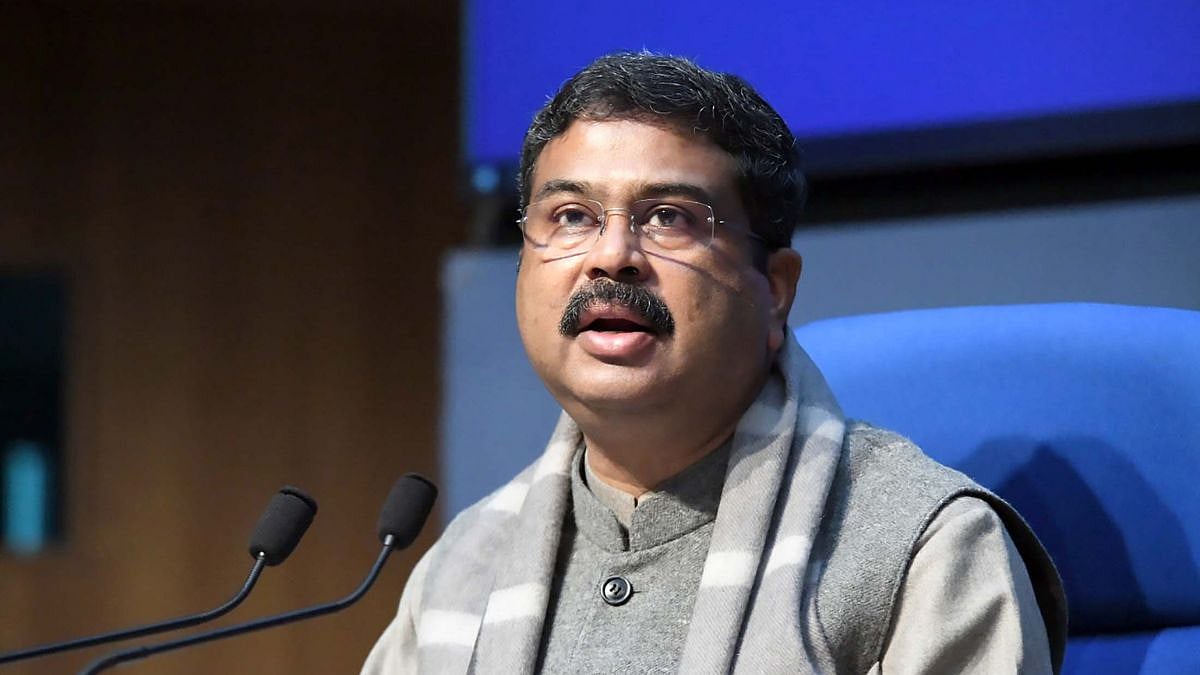
Union Education Minister Dharmendra Pradhan | File Pic
New Delhi: Union Education Minister Dharmendra Pradhan on Thursday said Vidya Bharati has served as an important reference point for the government in shaping the National Education Policy (NEP) 2020 and asserted that many of its practices have now been incorporated into the national curriculum.
Addressing a programme of Vidya Bharati here at the beginning of the new academic year, Pradhan said, "Although Vidya Bharati represents only around one per cent of the larger education ecosystem, that one per cent is like a drop of nectar.” He added that, “It has shown what the standards of education should be, what learning outcomes should be, what competencies should be, how teaching should happen, and what values should be imparted." Pradhan said he has been associated with the education department for the last five years, and Vidya Bharati remained a "successful reference point" whenever decisions were taken on textbooks, medium of instruction, language or social development.
"Whether it is textbooks, medium of instruction, language, or social development, I have considered Vidya Bharati to be a successful reference point," he said.
The Union minister said the government, under the leadership of Prime Minister Narendra Modi, introduced NEP 2020 and that Vidya Bharati was among the inspirations behind it.
"I can say with confidence that Vidya Bharati has been one of the inspirations behind the National Education Policy. The values, skill development methods, and teaching practices of Vidya Bharati have now been incorporated into the national curriculum," he said.
Several practices long followed by Vidya Bharati, including "bagless school days", mother tongue-based learning and continuous teacher training, are now being adopted nationally, Pradhan said.
ALSO READ
"The National Education Policy has said that there should be ten 'bagless school days'. Vidya Bharati had such a tradition from the very beginning," he added.
Highlighting the role of mother tongue in education, the Union minister said the new policy provides for teaching children in their mother tongue and state language in the early years, while Vidya Bharati went further by promoting four languages, including Hindi, Sanskrit and English.
"I believe in Vidya Bharati's mother tongue-based system of education, which increases clarity, critical thinking, design thinking, and productive thinking in children," he said.
Pradhan said India was moving away from rote learning towards creativity and critical thinking, and such a change could not come merely through books but through practice.
ALSO READ
He also urged Vidya Bharati to bring together voluntary organisations, NGOs and groups working in education, saying education should not remain confined to schools.
"Education happens in families, in society, in groups, and also in schools. Unless education becomes part of society, it will not become truly meaningful," he said.
"Earlier, there were only parent-teacher meetings, but we are now transforming that into school management committees and community-based responsibility for education," he added.
He said Vidya Bharati should expand its outreach beyond its present student base of 3.3 to 3.5 million, by producing free digital educational content on studies, values, skills, sports and holistic development.
The new National Council of Educational Research and Training (NCERT) textbooks for Classes 1 to 8 have been finalised, and Class 9 books would be available within a month, Pradhan informed.
He further said that India, for the first time, introduced computational thinking and artificial intelligence curriculum for students from Classes 3 to 8.
"Students will learn what artificial intelligence (AI) is, what its limits are, what its possibilities are, and how computational thinking can shape the future," he added.
Pradhan claimed that India's curriculum is emerging as one of the best in the world and that the country's preparations in artificial intelligence are ahead of many nations.
He also said sports, dance, music and skill development, for the first time, have been formally integrated into education under NEP 2020 and would eventually become full-fledged subjects.
Expressing gratitude to Vidya Bharati, Pradhan said, "Vidya Bharati has been a responsible guide for us, and that is why we have been able to move ahead," he said.
(Except for the headline, this article has not been edited by FPJ's editorial team and is auto-generated from an agency feed.)
RECENT STORIES
-
-
-
-
-