CBSE Revises NSP Framework For 2026-27; New Rules Introduce Changes To Scholarship Application, Verification
CBSE has revised the NSP scholarship framework for 2026-27, allowing students receiving welfare-based scholarships to also qualify for merit-based scholarships. The new framework also updates application and verification rules.

CBSE Revises NSP Framework For 2026-27; New Rules Introduce Changes To Scholarship Application, Verification |
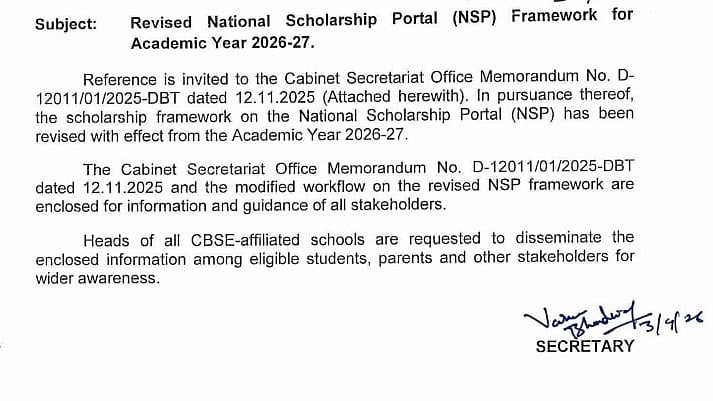
The Central Board of Secondary Education (CBSE) has informed affiliated schools about the revised National Scholarship Portal (NSP) scholarship framework for the academic year 2026-27, under which students receiving welfare-based scholarships will not be denied a merit-based scholarship if they subsequently become eligible for it.
The CBSE issued a public notice dated August 31, 2026, referring to the Cabinet Secretariat's Office Memorandum dated November 12, 2025, on the classification and harmonisation of scholarship schemes to prevent duplication.
The revised framework has been made effective from the 2026-27 academic year.
Merit & Welfare Scholarships classified separately
The Cabinet Secretariat has classified government scholarship schemes into two broad categories for the purpose of de-duplication and harmonisation.
Merit-based scholarships are awarded on the basis of academic performance, ranking or achievement in competitive or qualifying examinations. The primary objective of these schemes is to recognise academic excellence and promote merit. The National Means-cum-Merit Scholarship Scheme (NMMSS), Central Sector Scheme of Scholarships for College and University Students and INSPIRE are among the examples cited in the memorandum.
Welfare-based scholarships, meanwhile, provide financial support to students belonging to identified communities, categories or socio-economic groups. These schemes are intended to reduce financial hardship and promote equity. Pre-Matric and Post-Matric Scholarship Schemes for SC, ST, OBC and minority students are cited as examples.
Students can receive both types of scholarships
The Cabinet Secretariat memorandum states that if a student receiving a Welfare Scholarship subsequently becomes eligible for a Merit Scholarship, the merit scholarship should not be denied to them.
The same provision applies in the opposite direction. A student receiving a Merit Scholarship will not be denied a Welfare Scholarship if they subsequently meet the eligibility criteria for one.
The clarification forms part of the government's effort to establish a uniform approach to scholarship classification and de-duplication on the NSP.
Revised NSP Workflow
The revised framework also changes certain aspects of the application and verification process.
At the application stage, details entered during the initial application will be retained and reused for subsequent applications. Students applying for additional schemes will generally need to provide only scheme-specific details and upload the relevant documents.
If an application is marked defective, applicants will be allowed to edit scheme-specific details. However, if corrections are required in general, academic, institute or course details, all submitted applications will first have to be withdrawn.
At the Level 1 (L1) verification stage, tuition fees, admission fees and other non-refundable fee details updated during verification of the first application will be automatically populated in subsequent applications. The concerned Institution Nodal Officer (INO) will also be able to view all applications submitted by the applicant along with their respective status.
Deficiencies identified during verification will be categorised separately into those related to scheme-specific details and those related to general or academic details.
Applications to be visible across schemes
At the Level 2 (L2) verification stage, all applications submitted by a student, along with their respective status, will be visible to the concerned L2 Nodal Officers.
This is intended to facilitate consistency in decision-making when a student applies under different scholarship categories. For instance, if a student submits one application under a welfare-based scheme and another under a merit-based scheme, the L2 Nodal Officers handling both applications will be able to view the other application and its status.
The revised workflow also provides for applications to be flagged under a "Red Flag" category when deficiencies relating to general or academic details are identified.
CBSE asks schools to disseminate information
CBSE has asked the heads of all its affiliated schools to circulate the revised NSP framework among eligible students, parents and other stakeholders to ensure wider awareness.
The changes stem from the Cabinet Secretariat's review of issues encountered during implementation of the NSP de-duplication module for 2024-25, when some beneficiaries were flagged as duplicates across different government scholarship schemes.
The November 2025 memorandum noted that although the principle of "One Student - One Scholarship" is generally followed, different forms of financial assistance, support and incentives had sometimes been treated interchangeably as scholarships, creating overlaps in eligibility and implementation.
RECENT STORIES
-
-
-
-
-