Sensex Crashes 1,000 Points From Day's High, Know- 5 Key Reasons Behind Nifty's 200-Point Fall
Sensex tumbles over 1,000 points from its day's high as Nifty loses 200 points amid RBI liquidity concerns, foreign selling, profit booking, rising volatility and US bond yields.

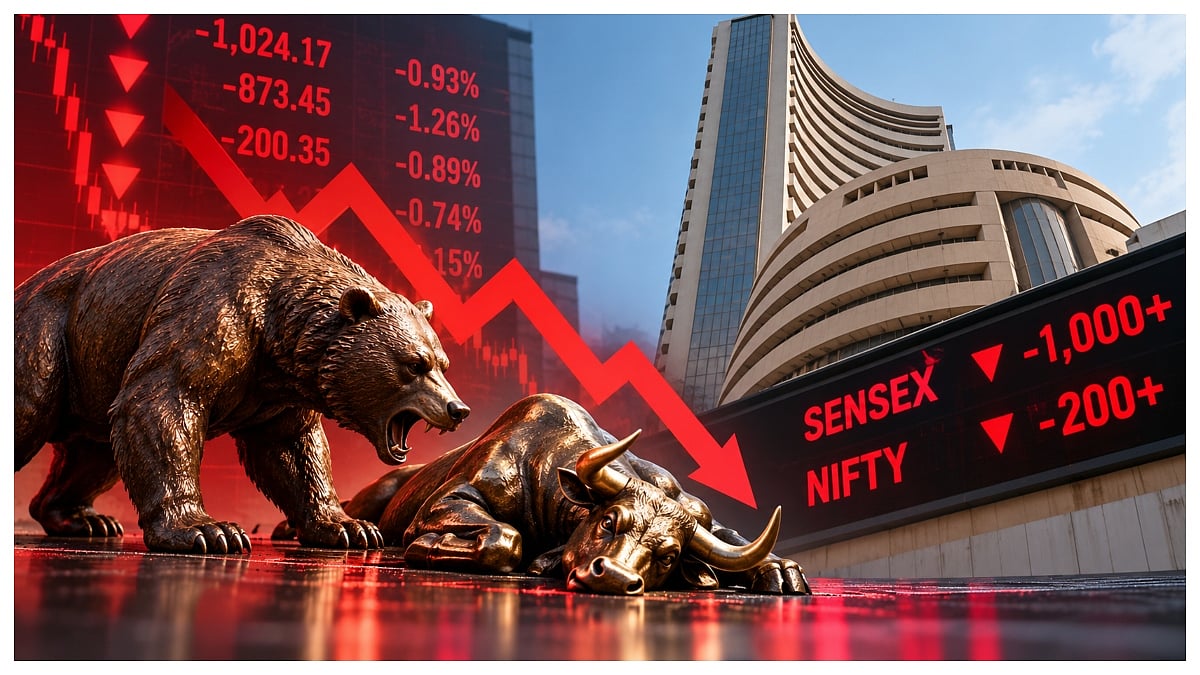
Sensex tumbles over 1,000 points from its day's high as Nifty loses 200 points amid RBI liquidity concerns. |
Mumbai: Indian stock markets witnessed a sharp reversal on Monday as the Sensex plunged over 1,000 points from its intraday high, while the Nifty declined more than 200 points despite a stronger rupee and softer crude oil prices.
Selling pressure intensified as investors booked profits, foreign fund outflows continued and concerns over banking liquidity increased.
Here are five major reasons behind the market decline:
RBI Liquidity Measures Raise Concerns
The Reserve Bank of India's (RBI) measures to support the rupee raised concerns about liquidity in the banking system.
The central bank will sell bonds worth Rs 25,000 crore on Tuesday to absorb excess liquidity.
ALSO READ
From October 16, banks must maintain 99 per cent of their required daily cash reserves, compared with the existing 90 per cent requirement.
This does not increase the Cash Reserve Ratio (CRR) but tightens daily compliance requirements.
Bank Nifty declined around 0.5 percent.
Profit Booking After Friday's Rally
Investors booked profits following Friday's strong market recovery.
On October 9, the Nifty had gained 288.65 points, or 1.30 per cent, to close at 22,520.45.
However, Monday's initial gains failed to sustain as selling emerged at higher levels.
Market analysts identified 22,600–22,650 as an important resistance zone, while 22,300 remains a crucial support level.
Foreign Investors Continue Selling
Persistent foreign institutional investor (FII) selling continued to weigh on market sentiment.
Foreign portfolio investors have withdrawn Rs 44,166 crore from Indian equities so far in October.
On October 9, foreign investors sold shares worth Rs 3,568 crore, marking their 11th consecutive selling session.
ALSO READ
Domestic institutional investors purchased shares worth approximately Rs 4,743 crore, partially offsetting foreign selling.
Market Volatility Rises
India VIX, the market's volatility indicator, climbed nearly 4 per cent, reflecting growing investor uncertainty.
A rising VIX signals expectations of sharper market fluctuations, although it does not necessarily indicate further declines.
Investors remained cautious about taking fresh positions.
US Bond Yields, Inflation Worries
Elevated US Treasury yields added pressure to Indian equities.
The US 10-year government bond yield hovered around 5.24 per cent, making American debt instruments relatively attractive.
Meanwhile, investors awaited domestic inflation data and quarterly corporate earnings.
Concerns over operating margins at DMart also contributed to cautious market sentiment.
RECENT STORIES
-
-
-
-
-