Centre Allows FDI In Inventory-Based E-Commerce Model Exclusively For Export Of Indian-Made Goods
The Centre has allowed FDI in the inventory-based e-commerce model exclusively for exporting goods manufactured in India. The policy aims to boost e-commerce exports and improve global market access while keeping existing restrictions on domestic inventory-based e-commerce and B2C retail unchanged.

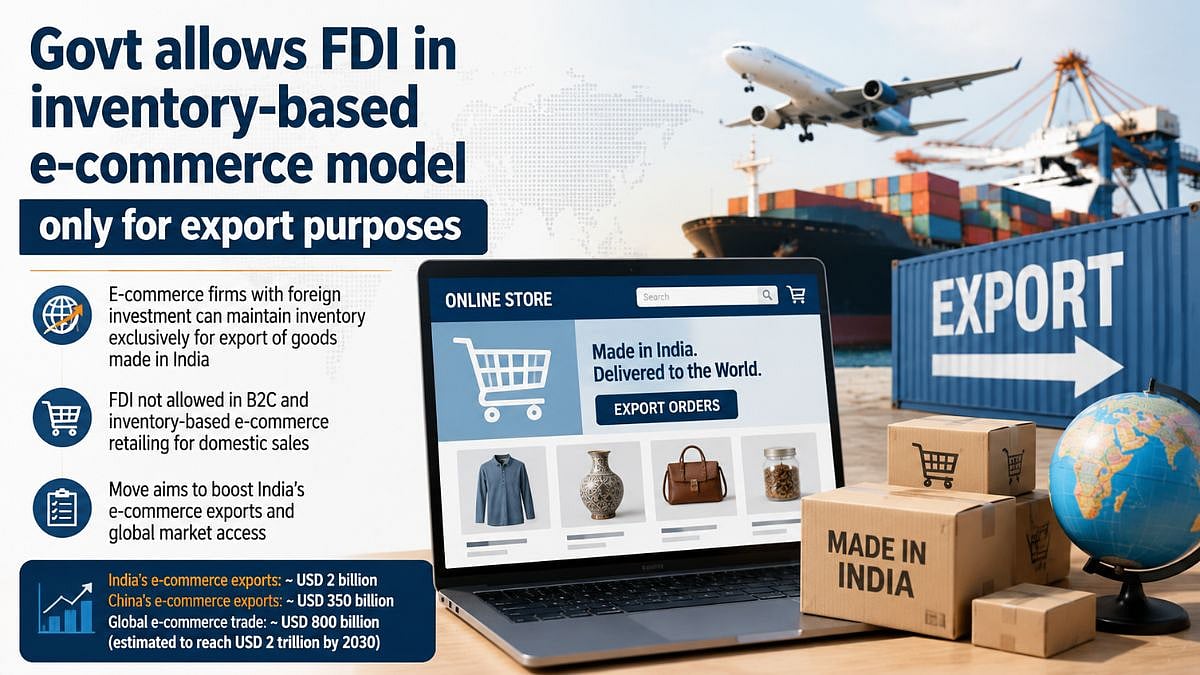
The Centre has eased FDI norms to allow inventory-based e-commerce operations exclusively for exports of goods manufactured in India | AI Generated Representational Image
New Delhi, July 23, 2026: The government on Thursday permitted FDI in an inventory-based e-commerce model exclusively for export purposes, a move that will help increase India's outbound shipments without impacting the businesses of small retailers.
These firms will have to export goods that are manufactured or produced in India. Also, FDI in inventory-based e-commerce retailing has not been permitted.
Policy Change For Exports
"In order to facilitate greater exports through easier and increased access to global markets by Indian sellers, the extant FDI Policy has been reviewed and it is decided that the restrictions on the inventory-based model of e-commerce shall not apply in the case of exports of domestically manufactured and/or produced goods/products," the Department for Promotion of Industry and Internal Trade (DPIIT) said in a Press Note.
This means that e-commerce firms with foreign investment can now maintain inventory only for export purposes. Earlier, the policy did not explicitly specify this.
DPIIT, an arm of the Commerce and Industry Ministry, deals with foreign direct investment (FDI)-related issues. It releases policy changes through Press Notes (PNs).
As per the current FDI policy, overseas investments are permitted in business-to-business e-commerce and marketplace models.
However, FDI is not allowed in business-to-consumer e-commerce and inventory-based e-commerce models, where the inventory of goods and services is owned by an online retailer and is sold directly to consumers.
DPIIT has inserted a clause in the policy, which states: "An e-commerce entity is permitted to engage in an inventory-based model of e-commerce exclusively for the export of goods/products manufactured and/or produced in India as per the applicable provisions of the Foreign Trade Policy 2023...and the Foreign Exchange Management (Export of Goods & Services) Regulations, 2015".
It added that the restrictions on B2C and the inventory-based model of e-commerce will not apply to the export of goods/products through e-commerce.
The decision will come into effect from the date of the FEMA (Foreign Exchange Management Act) notification, it said.
Boost To E-Commerce Exports
The proposal was initially mooted by the Directorate General of Foreign Trade (DGFT) to boost India's exports through e-commerce. E-commerce stakeholders, too, have demanded the same.
The decision is important as the government is looking at ways to boost exports through the e-commerce medium.
It is working on other measures as well, such as setting up e-commerce export hubs.
As per estimates, the country's e-commerce exports are about USD 2 billion currently, compared to China's staggering USD 350 billion.
The global e-commerce trade is about USD 800 billion and is estimated to reach USD 2 trillion by 2030.
Industry Reaction
Commenting on the move, an industry official said that this is a positive step to facilitate exports through e-commerce and improve global market access for Indian manufacturers and sellers.
"The notification is specifically aimed at exports and should be viewed in that context. It does not alter the existing policy framework for domestic e-commerce, under which companies like Amazon, Flipkart, Meesho, etc. operate," the official said.
Also Watch:
ALSO READ
However, certain exporters have raised concerns that the decision may impact small exporters, as they would now face competition from big e-commerce firms operating from India.
(Disclaimer: Except for the headline, this article has not been edited by FPJ's editorial team and is auto-generated from an agency feed.)
RECENT STORIES
-
-
-
-
-