Tome And Plume: MP Villages That Don’t Treat Ravana As Villain, Rather Worship Him
While Ravana's effigies are burned during Dussehra, four Madhya Pradesh villages worship him instead. Residents of Ravangram, Khanpur, Chikli and Ravanwara revere Ravana as a family deity, son-in-law, scholar or protector. Their unique traditions, temples and rituals highlight the state's diverse cultural beliefs and interpretations of the Ramayana.

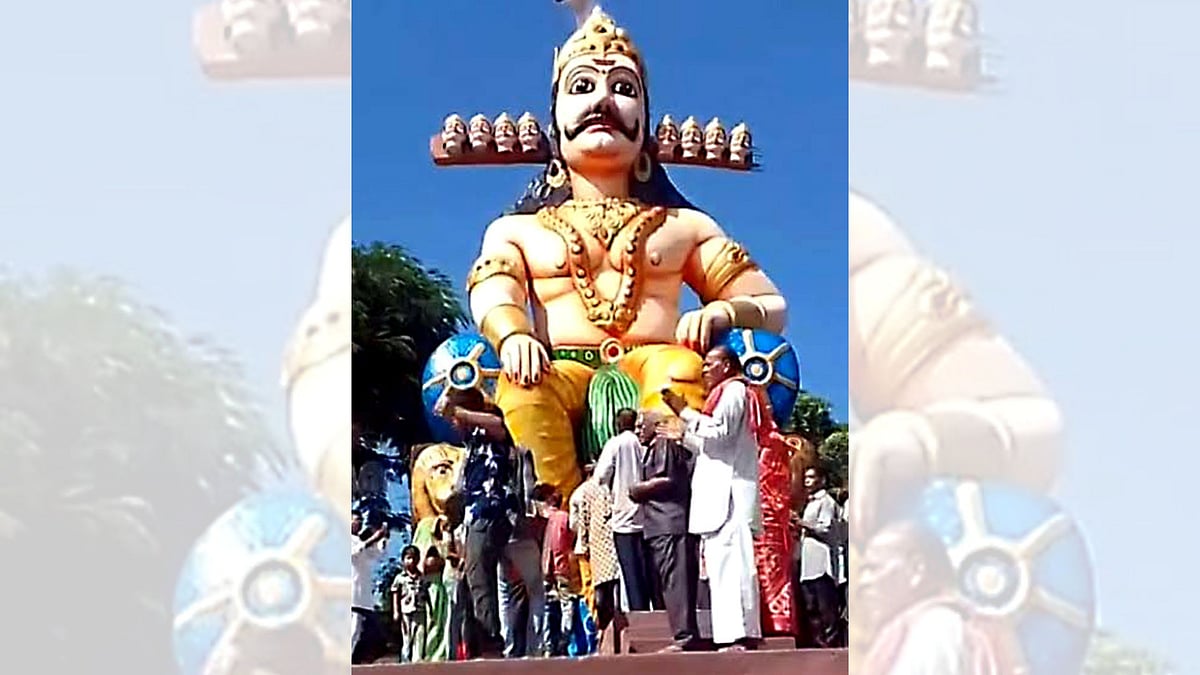
Tome And Plume: MP Villages That Don’t Treat Ravana As Villain, Rather Worship Him | FP photo
Bhopal (Madhya Pradesh): Meghnad Badh Kabya, Michael Mudhasudan Dutt (Translated from Bengali by William Radice)
Every year, on Vijaya Dashami, the welkin lights up with the spectacular end of demon King Ravana, his brother Kumbh Karan, and his son Meghnad, or Meghnath. People dance in joy to the sounds of popping bangers as the bamboo frame of the effigies goes into flame. It tells us a tale: God wins, the fallen angel loses.
The burning of effigies signals the denouement of the nine-day Navratri festival. Ravana has been an epitome of evil to the majority of Indians since time immemorial. But the people of Ravangram in Vidisha, Khanpur in Mandsaur, Chikli in Ujjain, and Ravanwara in Chhindwara do not treat Ravana as a villain. Nor do they celebrate Vjyaya Dashami. Rather, they worship him. The residents of Khanpur village in Mandsaur treat Ravana as their son-in-law and Queen Mandodari as their daughter. A faith permeates the villagers that Mandsaur remained the birthplace of Mandodari. They also believe the modern name Mandsaur has evolved from her name. Ergo, locals, particularly those belonging to the Namdeo Vaishnav Samaj, view Ravana as their son-in-law. Khanpur has an ancient temple where locals have installed his statue. The earlier idol, which locals call ancient, fell to lightning. They installed another idol, replacing the old one, which is over 40 feet tall. Whenever women pass by the temple, they cover their heads out of respect. Believers also tie a red thread around the left leg of the statue, seeking relief from diseases.
The Chikli village in Badnagar Tehsil, 20 km off Ujjain city, too, has a temple of Ravana. Residents say the temple belongs to the ancient period. The temple houses an eight-foot-tall stone statue of Ravana. Locals treat him as a scholar and devotee to Lord Shiva. Locals gather at the temple and offer prayers before the idol of Ravana during the Sharadiya Navratri. A fair takes place during the Chaitra Navratri in April when they honour him, believing skipping the temple brings bad luck because he performed penance in Ujjain to get the blessings of Lord Shiva.
Chhindwara has a village, Ravanwara, where people, belonging to the Gond community, offer prayers. The temple stands over 20 km away from the district headquarters. Locals treat Ravana as the guardian of the village who protects them from danger. Legend has it that Ravana had many magical powers, including curing people from various ailments.
The temple stands atop a hillock in the coal-mine area of the Pench valley. The main feature of the temple remains the stone inscriptions and rock carvings, which the locals point to the village’s historic links with Ravana. When the effigies of Ravana go into flame, villagers gather at the temple to offer prayers before the deity. Similarly, when others light lamps to celebrate Diwali, locals observe mourning. Then the temple remains unlit.
They also worship Nikumbhila or Nikumbala, the clan deity of Ravana. The temple stands in Umreth village, 28 km away from the district headquarters. Locals visit the temple to seek her blessings. The temple houses an ancient idol of Nikumbhila standing with folded hands.
The Vidisha district has a village, Ravangram, nearly 40km from its headquarters. A temple of Ravana exists there. The people belonging to the Kanyakubja Brahmin community, a sub-sect of the Brahmins and mythologically claiming Ravana’s lineage, trace their origin back to the epic figure. They worship him as Kul Devata, or Ravana Baba Maharaj.
The residents of Ravangram head to the temple before any auspicious occasion. They send the first card to the temple before solemnising any wedding ceremony. When children return from school on their bicycles and pass by the temple, they chant, 'Jai Lankesh…'. Jai Lankesh…'
The Ravana temple in Madhya Pradesh show how different cultures, religions, and beliefs have co-existed in the state since the days of yore.
ALSO READ
RECENT STORIES
-
-
-
-
-