Tome And Plume: Holi Traditions In Bhopal Through Eyes Of Time
In Bhopal, Holi once featured natural colors from Palash flowers, cow dung, and mud, beside the Upper Lake built by King Bhoj. Gujiya, earlier called Karanika, evolved over centuries. During the Nawabi era, rulers like Sikandar Jahan Begum celebrated grand “Begum Wali Holi.” Though modern celebrations use chemical colors, the festival’s spirit endures.

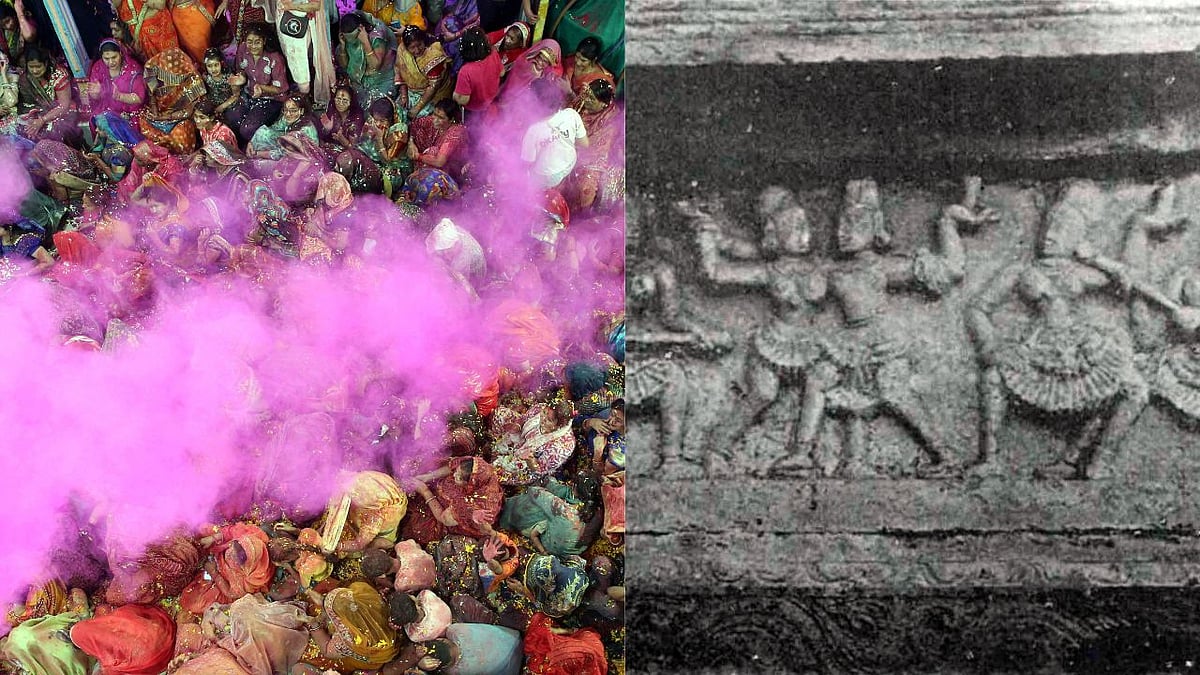
Tome And Plume: Holi Traditions In Bhopal Through Eyes Of Time | FP Photo
Bhopal (Madhya Pradesh): The residents played Holi with colours made from Palash, or Tesu flower and used cow dung, mud, and water
In the Mauryan era, gujiya called karanika, was prepared with sun-dried jaggery, honey, dry fruits, and ghee, but its present form may have come into existence since 1700 CE
In the distant past, as the moon of March would pour down its silvery light over the wavy waters of the Upper Lake that King Bhoj brought into existence, Bhopal woke up to light the Holika fire.
The residents gathered on the roads to set the replica of Holika, the sister of the demon king Hiranyakashipu, aflame.
It happened long before the soft, melodic Urdu poetry rang out in the mediaeval auditoriums and long before the minarets of the huge buildings stood against the smokeless welkin.
It was the night when the residents lit the pyre of the demoness as a symbol of the victory of good over evil.
The fire of the replica of Holika died down, leaving the glowing embers. Then dawn broke, setting the Upper Lake aglow. Men, women, and children set out from their homes with gulal, colours made from the petals of Palash and other spring flowers and from the barks of mango and jamun trees, for there were no chemical colours.
Some people also used cow dung and mud in place of colours in those days. Use of cow dung and mud in Holi is still in vogue. Thandai was also distributed.
Gujiya, then called Karanika in Sanskrit, was part of the festival, but it was made of sun-dried jaggery, dry fruits, ghee, and honey. Its modern form came into existence in 1700 CE.
As gujiya is culturally associated with the Bundelkhand region, the mawa-filled sweetmeat may have existed in 1300 CE.
In Bhopal, and its surrounding areas, Gujiya was perhaps called Kusli.
This was how ancient Bhopal used to celebrate Holi, but it was not merely playing with colours. It was the ritual of renewal when the lake mirrored hundreds of tinged faces. They teased each other and promised that spring would always return and love would exist.
The pages of the ancient era slowly entered the mediaeval period. The system of celebrating Holi slightly changed, but its spirit remained the same the victory of good over evil.
During the Nawabi era, the celebration of Holi was a grand display of faith, elegance, and joy.
Holi was a special occasion during the reign of Sikandar Jahan Begum and Sultan Jahan Begum.
The women of the royal family and other women used to celebrate a special Holi, called Begum Wali Holi, inside the palace. They applied colours on each other, danced, and sang in joy. Most of the colours they used were made from herbs and contained the fragrance of various flowers.
At noon and in the evening, special dishes containing delicious flavours, like Sheermal, Zarda Casserole, Mutton Korma, and Khoye ki Gujia, were prepared for the guests. Begum Wali Holi is around 325 years old.
After Nawab Hamidullah Khan took over the reins of power, he held Holi Durbar at the Ahmedabad Palace. People belonging to different faiths gathered to wish the Nawab a happy Holi, and Hamidullah Khan reciprocated it with equal generosity.
The people also applied Gulal and sprinkled odorous water on the Nawab.
Besides its capital, the state has been connected to the Holi festival since time immemorial. Stone sculptures found in Ramgarh and Khajuraho confirm the historicity of Holi celebrations in the state.
A stone sculpture found in Ramgarh, Vidisha, depicts women with Pichkaris (water guns). It captures the joy and cultural spirit of the festival. The sculptures found in Khajuraho also limn a few scenes of Holi.
The Holi festival, or Vasantotsava, or Madanotsava, figures in Kalidasa s Malavikagnimitram, Dandin s Dasakumaracharita, and Sri Harsha s Ratnavali.
But the way of its celebration was different from what it is today. Today, the residents of Bhopal celebrate the festival with chemical colours and amid the honking of vehicles. Yet its spirit pulsates in the abyss of the past.
ALSO READ
RECENT STORIES
-
-
-
-
-