Tome And Plume: George, Or Well, Let’s Write Simple Sentences
What the British speak or write is not the same as what the people of other countries, including those in the USA, do. The British write the spellings of many words differently, causing trouble for the people of India and other countries. The British sentence structure is also different. There have always been debates over whether 'however' should be at the beginning of a sentence.

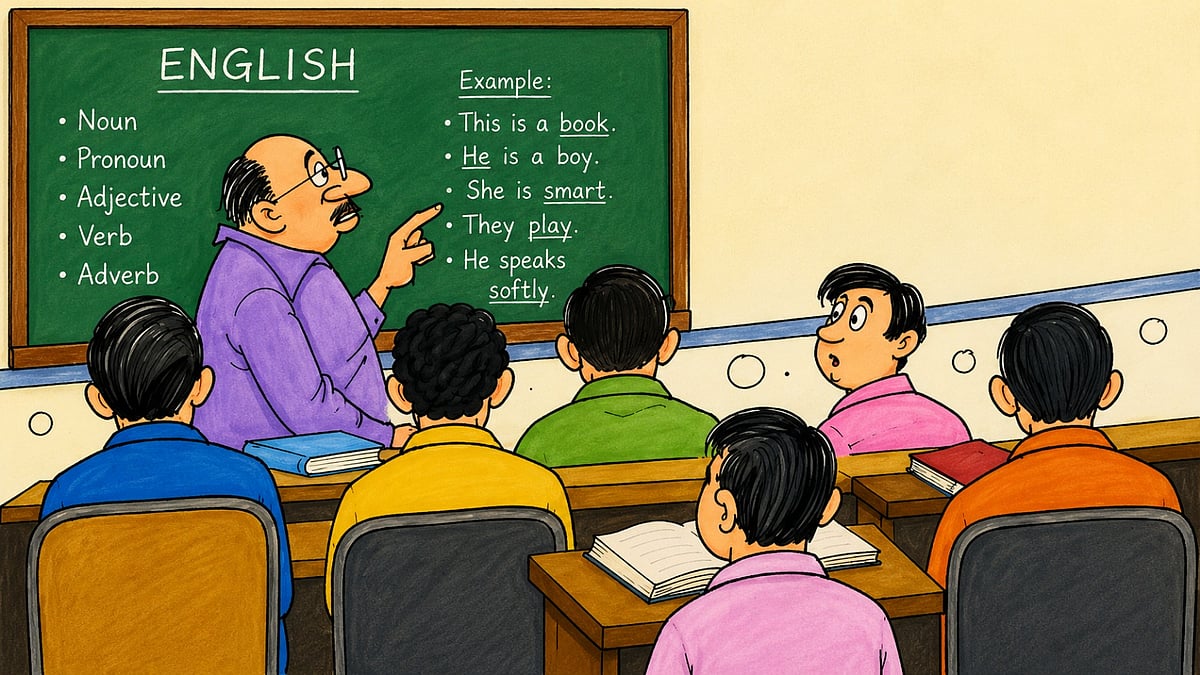
Tome And Plume: George, Or Well, Let’s Write Simple Sentences | FP Photo
Bhopal (Madhya Pradesh): In English writing, we seldom speak of tradition, though we occasionally apply its name in deploring its absence, Tradition and the Individual Talent, T. S. Eliot
Writing in the English language is an onerous task. A non-native speaker, attempting to jot down a few words in that language, encounters innumerable difficulties. Until he reads more, writes much, and forms a habit, he cannot perfect the language.
The lack of proper training in grammar, phonology, etymology, and oral expressions since childhood remains a complexity for a non-native speaker of the language.
What the British speak or write is not the same as what the people of other countries, including those in the USA, do. The British write the spellings of many words differently, causing troubles for the people of India and other countries.
The British sentence structure is also different. There have always been debates over whether 'however' should be at the beginning of a sentence or in the middle.
The Americans put it at the beginning of a sentence as an adversative conjunction. But the British grammarians differ from their US counterparts, saying ‘however’ as an adversative conjunction at the beginning of a sentence loses its depth.
They say the half-adverb and half-conjunction, 'however,' should come immediately after the item it contrasts with. ‘However,’ at the beginning of a sentence, means 'in whatever way or to whatever extent.' In this sense, it modifies an adverb or an adjective. For example, however tired she felt, she would strengthen her love. To show the contrast at the beginning of a sentence, we have "but," "nevertheless," and "nonetheless."
The AI grammar checker is too weak to withstand the pressure of 'however.' It always uses this fine adverb, or one may call it a conjunction, at the beginning of a sentence, but Gen-Z grammar, which AI may love to be called, is still far behind the modern language system.
The styles of the BBC, The Guardian, and The Times are still the best, which everyone may follow. An example culled from The Times, London, shows the lucid style of writing: political pressure on Labour leadership remains a unifying theme across the UK as internal divisions resurface over the latest economic forecasts.
Another sentence, from the BBC, consists of lucidity and simplicity: Nearly three weeks after an Indian family of four was found dead in their home, investigators tell the BBC they are no closer to knowing what actually happened.
The present political anarchy, if we go by what George Orwell, or well, by what many wise men say, is the outcome of the degeneration of language and thought. Old George, though he never grows old, suggests, "If you simplify your English, you are freed from the worst follies of orthodoxy."
Similarly, the British style does not give an approving nod to the way we employ the half-conjunction, half-adverb "as." The simple writing discards the employment of conjunctions without a reason.
We structure sentences to generate ideas, but a piece of fine writing is just the opposite; it is the ideas that spawn sentences.
Many writers have heavily taxed ‘as’ for ‘because’ and made it overwork, mostly without any valid reasons but enamoured by its brevity for centuries, often leading to ambiguity.
‘As’ employed for ‘for’ and ‘because’ is not agreeable to the properly tuned English ears; rather, it is colloquial, and the word has more than one connotation. It implies time, reason, and likeness. This two-letter word, which we call "as," finds itself in many expressions, and to use it, a writer must have a command of English verbs.
Every nation has a different mindset, on which depends the employment of a language, but many of us are oblivious to it.
Rather than taxing our expressions with high-sounding adjectives and illogical conjunctions, as AI grammar leads us into doing, our efforts should be to write simple, lucid, and grammatically correct Orwellian sentences.
Arup Chakraborty
RECENT STORIES
-
-
-
-
-