The Business Case For AI Is Unclear; The Empire Case Is Not
AI is increasingly becoming a contest for geopolitical influence rather than just commercial success. The article argues that countries leading in advanced AI models, computing infrastructure and technical standards could shape global power, technological sovereignty and economic influence for decades.

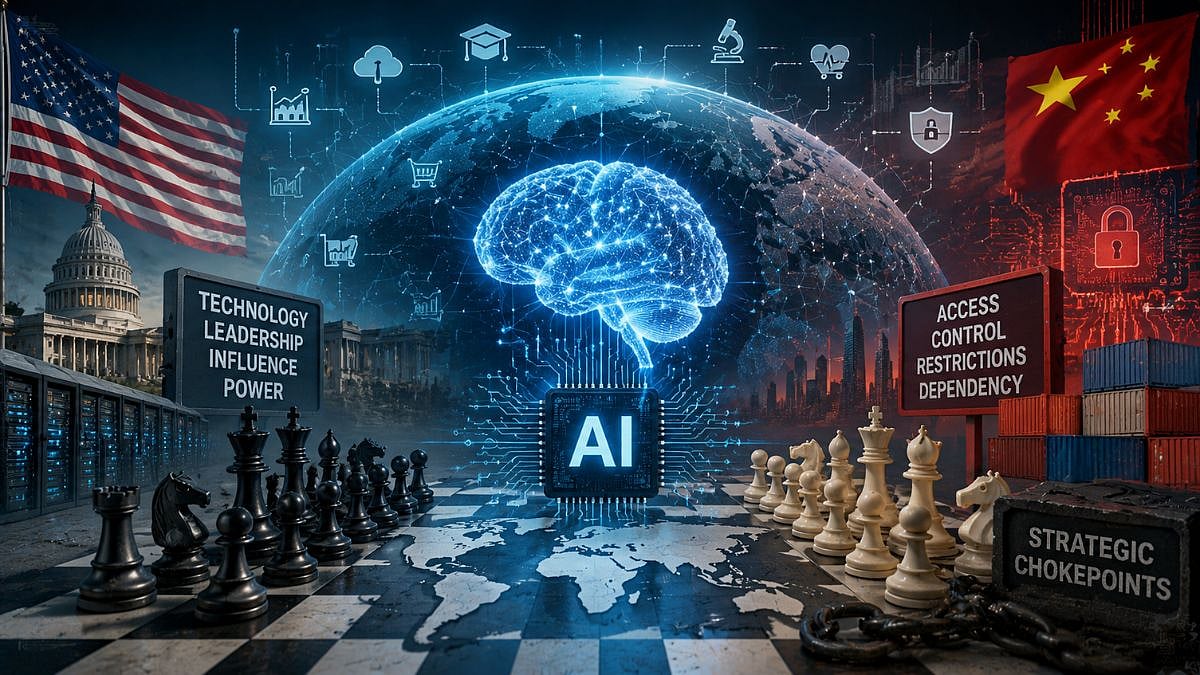
The article explores how artificial intelligence is emerging as a strategic tool for geopolitical influence and technological leadership | AI Generated Representational Image
The most consequential technologies in history were not always adopted because their commercial value was immediately obvious. Many became important because they altered the global balance of power. Railways expanded markets, but they also enabled states to project authority across vast territories. Nuclear technology produced energy, but it also created a new geopolitical order. The internet transformed commerce, but it also became an instrument of influence.
The world is currently witnessing an unprecedented wave of investments in AI. Governments and corporations are spending hundreds of billions of dollars on chips, data centres, research and talent acquisition. Will the economics justify the investment? The answer is far from certain.
Despite extraordinary progress, no one can confidently estimate the eventual revenues, margins or long-term profitability of many AI initiatives. Investors continue to debate whether the technology is overhyped or undervalued.
But the debate may be missing a larger point. Even if the business case for AI remains uncertain, the geopolitical case is remarkably clear.
Technology As Strategic Power
For decades, the United States has demonstrated how technological leadership can translate into global influence. Military strength has undoubtedly played a role, but American power has often rested on something deeper: control over systems that other countries needed access to. The dominance of the dollar gave Washington unparalleled influence over global finance. Access to American markets shaped trade negotiations. Control over critical technologies provided leverage that often extended far beyond economics.
Throughout the Cold War and beyond, access to advanced nuclear technologies was tightly controlled. Countries seeking civilian nuclear cooperation frequently found themselves navigating geopolitical considerations alongside technical requirements. Strategic technologies rarely moved independently of strategic interests.
The same pattern appeared in defence. Advanced fighter aircraft, missile systems, satellite capabilities, encryption and other sensitive military technologies were often supplied selectively. Access was not merely a commercial transaction; it was frequently accompanied by political conditions, strategic alignment and long-term dependencies. Nations that relied on foreign defence ecosystems often found that procurement decisions created relationships lasting decades.
Technology became influence; influence became power. Artificial intelligence has the potential to elevate this dynamic to an entirely different level.
AI As Foundational Infrastructure
Unlike nuclear technology or advanced weaponry, AI is not confined to a specific sector. It is a foundational capability that can permeate almost every aspect of modern life. Healthcare, education, manufacturing, logistics, scientific research, finance, agriculture, communications and national security are all likely to be transformed by increasingly sophisticated AI systems.
This breadth is what makes AI unique.
If a small number of countries achieve a decisive lead in frontier AI, they will not simply possess superior systems. They will control a foundational layer of future economic and military activity.
They will own the most advanced models. They will possess the computing infrastructure required to train them. They will influence technical standards. They will attract the world’s leading researchers. They will shape the platforms upon which others build. Most importantly, they will occupy the strategic chokepoints through which innovation increasingly flows. History shows that whoever controls chokepoints acquires influence far beyond their numerical strength.
Consider how access to advanced semiconductors has become a geopolitical issue. Nations across the world are discovering that technological sovereignty is difficult to achieve when critical components are concentrated in a few locations and controlled by a small number of players.
The same logic is now beginning to extend beyond hardware. The United States has recently moved to restrict the overseas availability of certain frontier AI capabilities developed by its own companies, requiring government approval before some of the most advanced models can be made available abroad. The objective is to control access to intelligence itself.
The Future Of AI Leadership
Artificial intelligence could create dependencies on a much larger scale.
Imagine a future where businesses rely on advanced AI systems to design products, optimise supply chains, conduct research and interact with customers. Imagine governments using AI to deliver public services, manage infrastructure and strengthen national security. Imagine universities, hospitals and laboratories depending on AI capabilities that only a handful of countries can provide at the highest level.
In such a world, access itself becomes a source of power.
Priority access can be granted. Restrictions can be imposed. Capabilities can be withheld. Terms can be dictated. Standards can be established. Dependencies can be cultivated. None of this requires military intervention. Yet, all of it can influence the choices available to nations and institutions.
This is why the race for AI leadership increasingly resembles earlier geopolitical competitions.
The participants understand that the objective is not merely to create profitable products; it is also to secure a commanding position within the architecture of the future.
Nations invest differently when they perceive a technology as a source of long-term influence. Artificial intelligence increasingly falls into that category. This does not mean global dominance by any single country is inevitable. Technological leadership evolves. New competitors emerge. Open source innovation may democratise access. Governments will seek to prevent excessive concentration of power. The future remains uncertain. What is certain, however, is that artificial intelligence is no longer merely a business story; it is a story about power.
The debate over AI often revolves around productivity gains, job displacement, ethics and regulation. Important as these questions are, they overlook a more fundamental issue: Who will control the infrastructure upon which future intelligence depends?
The answer will shape far more than corporate profits. It will shape influence; it will shape sovereignty; and it may determine who exercises global dominance in this century.
The writer is a retired IRS officer and former Chief of Surveillance at SEBI, and an adviser to corporates, market participants and technology entrepreneurs.
Published on: Wednesday, July 01, 2026, 10:09 PM ISTRECENT STORIES
-
-
-
-
-