Making Sure Peace Prevails On Public Transport
Indian Metro and railway authorities are penalising passengers who play music or videos aloud on mobile phones. Bengaluru and Chennai Metro Rail impose Rs 2,500 fines, while Southern Railway levies Rs 1,000 and may remove offenders. Public awareness, warnings and responsible headphone use are essential to maintain peace during travel.

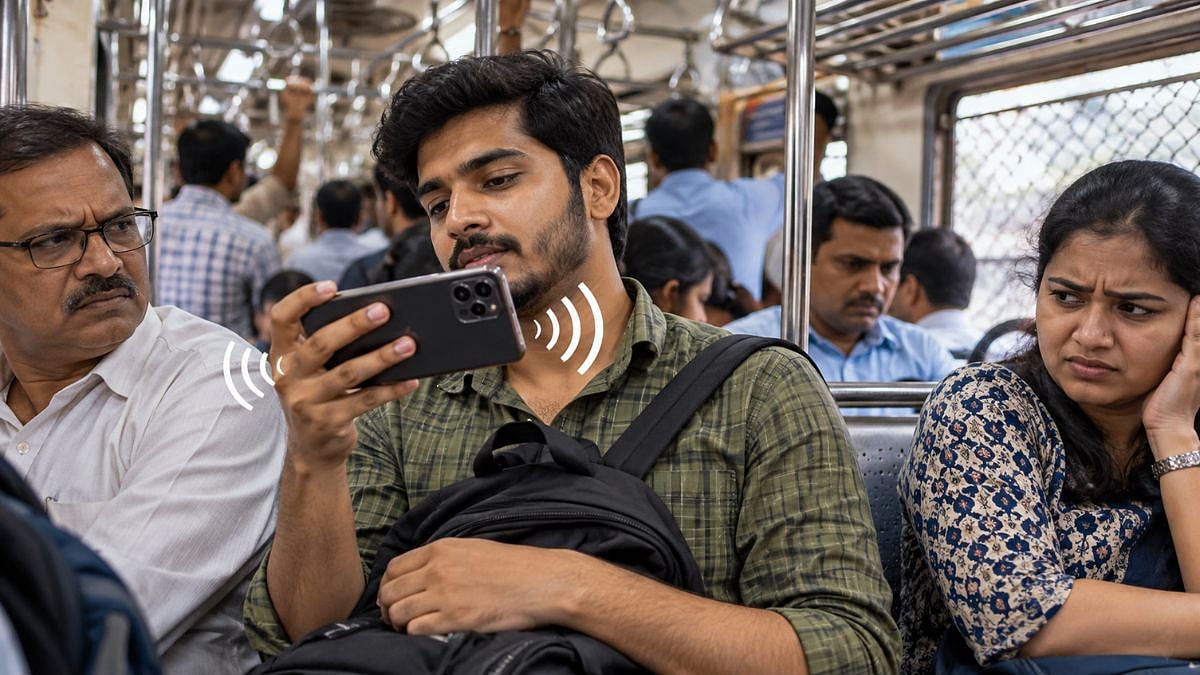
Railway and Metro authorities are cracking down on passengers playing music and videos aloud on mobile phones to maintain a peaceful travel environment | AI Generated Representational Image
In the best of times, public spaces in India are a cacophonous riot, swamped by the noise of incessant honking, rattling vehicles on bad roads, vendors on megaphones and music playing from loudspeakers. Loud construction equipment operates late into the night in many cities. Some of that discordance is carried over to public transport, including quiet Metro carriages and air-conditioned train and bus coaches.
In response, Bengaluru and Chennai Metro Rail earlier, and Southern Railway now, have announced penalties for travellers who play music or videos on their mobile loudspeakers, causing annoyance to other passengers. The fine on Namma Metro in Bengaluru and the Chennai Metro was set at ₹2,500, while the Railways will levy ₹1,000, besides removing offenders from railway premises, including carriages.
But laws and rules alone are not efficacious in bringing about a modicum of order. In some cities, bus drivers use boomboxes to play their own music from phones. The amended Motor Vehicles Act has also failed, and it is largely left to the conscience of the motorist to remain civil. Things may not be very different with the ‘silence’ rule on public transport.
What is interesting is that the issue is global. London has announced a £100 fine for ‘loudcasting’, where the recalcitrant traveller virtually forces others to listen to their choice of entertainment. British Prime Minister Andy Burnham is leading the campaign to “share the carriage, not the noise”. New York has a $25 fine for media devices, which is rarely enforced.
Building Awareness Beyond Penalties
Advancing the ‘headphones only’ rule would depend on convincing passengers through mass media campaigns that a noisy presence on a train or bus is not just unlawful but also uncivil. Blaring songs can also be counterproductive when multiple people do the same, akin to the futility of honking on Indian roads to alert people to danger because almost everyone else is doing the same for no reason.
It may be more useful to address the campaign to students and young people, who are likely to retain the message. Another option is to use information screens at railway and Metro stations, and even other public places, to warn people about penalties. A strict announcement by police using a megaphone on a train may also convey the administration’s seriousness. Compelling an errant traveller to buy a pair of headphones on the spot may be yet another option, rather than imposing a fine in the first instance.
What stands out in contemporary rail travel is the movement of large numbers of low-paid, poorly educated workers from distant states to metropolitan cities, and the doom-scrolling of noisy reels that is their only means of relief from boredom. Whether they would spend an additional ₹100 on a pair of headphones is a moot question. Yet every effort to achieve some quiet would be worthwhile.
To get details on exclusive and budget-friendly property deals in Mumbai & surrounding regions, do visit: https://budgetproperties.in/
RECENT STORIES
-
-
-
-
-