Democracy Dies At Ballot Box But Lottocracy Isn’t The Answer
Democracy is under pressure as elected leaders concentrate power, weaken institutional checks and expand oligarchic influence. Citizens’ assemblies may strengthen public participation, but lottocracy is not the answer. New models are needed to make democracy more meaningful and accountable.

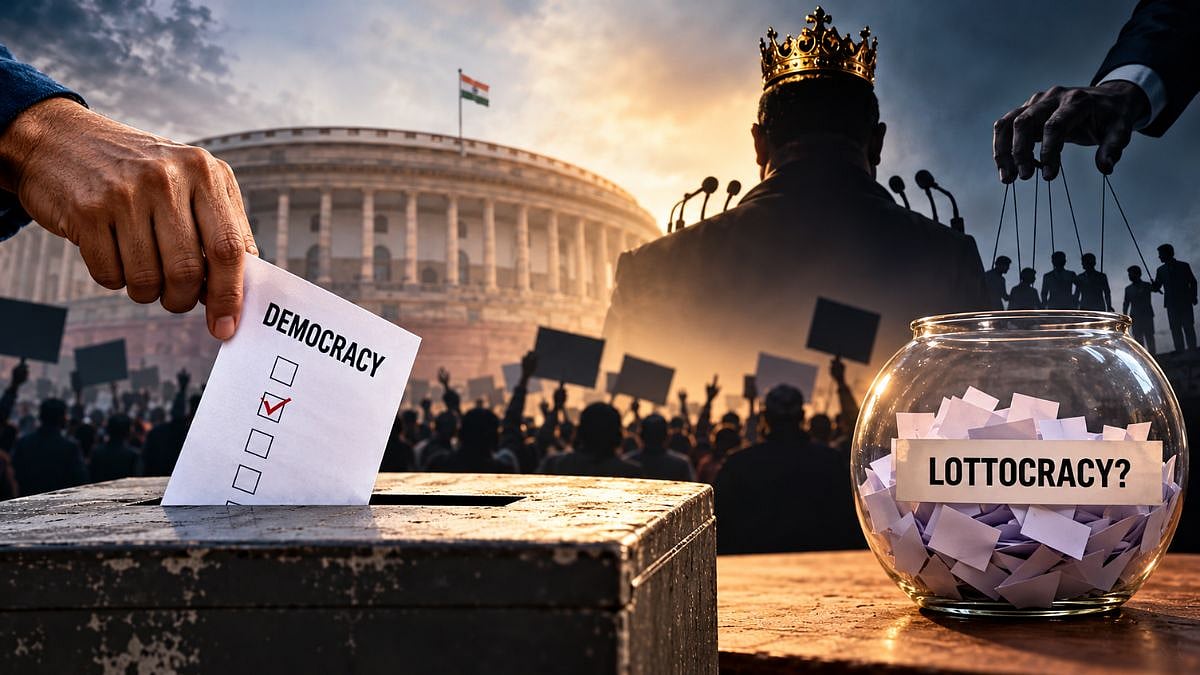
Growing executive power, oligarchic influence and weakening democratic institutions are intensifying concerns about the future of representative democracy worldwide | AI Generated Representational Image
Democracies don’t die at the hands of military despots anymore. Now, elected autocrats use a new template to smother democracy: changing the rules of the game. Stephen Levitsky, professor of government at Harvard University, says that “capturing the referees” and “changing the playing field” are ways to stifle democracy. Democracy now dies at the ballot box, literally.
Globally, democracy is going through an intense phase of regression. Democracy finds itself in distress and is becoming increasingly dysfunctional. India’s democratic success, despite massive poverty and illiteracy, confounded legions of naysayers. Eminent British journalist and writer Bernard Levin went so far as to say, “If democracy dies in India, the end of democracy itself will be in sight.”
Long lauded for bearing the torch of democracy, India today exemplifies the global democratic recession. Today, the world’s largest democracy is increasingly viewed as a “flawed democracy” and an “electoral autocracy”. Oxford professor Maya Tudor argues that India’s recent downgrade “to a hybrid regime is a major influence on the world’s autocratisation”.
Is The Romance With Democracy Over
When hawks were hawks and doves were doves, American democracy theorists used to say that democracies don’t fight each other. Democracy’s long run has ended. Today, public dissatisfaction with democracy outweighs satisfaction across 12 high-income countries that the Pew Research Centre has surveyed consistently since 2017.
As British academic Catherine Rowett argues, democracy survives on lies. Plato, in The Republic, famously said that a noble lie binds society together. Modern democracy also depends on a democratic myth: equal votes and equal capacity. Plato’s ideal state has become a blueprint for the worst kind of political oppression. In ancient Rome, citizens renewed their vow of loyalty to the emperor. Modern democratic emperors expect the same.
Many democracies have thrown off old gods and ended up embracing new gods. Strong gods command loyalty, love, passion and sacrifice. A significant proportion of the human race has voluntarily retreated to Plato’s cave. The “cocoons of flattery”, Hannah Arendt has famously said, “seal off such leaders from the real-world consequences of what they do.”
The Rise Of Post-Democracy
Democracy may not be doomed yet. But the world is now wrestling with what political scientist Colin Crouch calls ‘post-democracy’ or ‘de-democratisation’. Post-democracy is not a formal abolition of democracy. We still have parliaments, elections and political parties. But real power doesn’t lie with Parliament; it lies with the government and its all-powerful leader.
Giorgia Meloni’s premierato reform is viewed as a rewriting of Italy’s post-fascist constitution. It provides for the direct election of the prime minister. Premierato is the introduction of a form of government largely unknown in other political systems. Under Modi, the PMO is virtually the executive, and a push for ‘One Nation, One Election’ may take the country into unknown territory.
What Meloni and leaders of her ilk have done is seek to transfer power from parties and parliaments into the prime minister’s hands. Democracy has entered a phase of power without accountability. America’s big tech bros, the “broligarchs”, are now shaping American politics. The trillionaires and billionaires now run democracy with their dark money.
From Strong Government To Neo-Monarchy
The BJP came to power on the promise of “less government and more governance”. But what one sees is more government and less governance in the name of security. The government has neither kept its economic promises, including lowering taxes, nor its sovereigntist promises.
We are heading towards an ultra-capitalist and hyper-technological neo-monarchy. The victory of Trump and others is a win for oligarchs, autocrats and their patrons of all shapes and kinds. We are witnessing a ‘democide’—democracy being killed in the name of democracy.
The end of democracy has already begun. The autocratic tactics used to downgrade democracy are there for all to see. Democracy’s guardrails, which prevent a leader from usurping power, are being dismantled. Democrats are embracing the strongman’s cult.
British journalist Paul Mason says in his book, How to Stop Fascism, that modern fascism is “internationalist in design and overly structured around a theory of victory”. A key source of its strength in the 21st century is technological proficiency and cross-border digital networks.
Democracy’s drift towards autocracy has been variously described as ‘illiberal democracy’, ‘democraship’ and ‘democratura’. Some democracies have become ‘broligarchy’.
The Crisis Of Representation
Liberal democracy has suffered on account of two factors: the crisis of representation and the decline of party democracy. Experience suggests that democracy and capitalism are incompatible. Milton Friedman’s argument that capitalism is democracy’s natural home sounds farcical and comical today.
What we have is what British sociologist Sheldon Wolin calls a “managed democracy”. All heroes have flaws. With democratic autonomy becoming extractive, with control in the hands of one leader, India is fast becoming a “big state” which prevents people from growing.
Democracy doesn’t need heroes but citizens. As German poet and playwright Bertolt Brecht warned us, “Unhappy the land that is in need of heroes.”
Democracy loses its shine when politics becomes burlesque and election campaigns become smoke and mirrors created by publicists, marketing agencies, scriptwriters and pollsters.
Why Lottocracy Isn’t The Answer
How can the ills afflicting democracy be addressed? Helene Landemore of Yale University favours instituting novel forms of non-electoral democratic representation. However, lottocracy isn’t the answer. Landemore favours lottocracy, in which representatives don’t run for office but are randomly selected to serve fixed political terms.
Australia, Ireland, France, Germany and some other countries have introduced citizens’ councils to deliberate on topics such as climate change and artificial intelligence. In 2021, civil society organised the first global citizens’ assembly at the UN Climate Conference. Across the world, citizens’ assemblies have sought to bring a diverse group of people together to make democracy more meaningful.
Modern democracy has become increasingly oligarchic. As Landemore says, our Parliament today “is gated and guarded” and only certain people “with the right suit, accent, wealth and connections are welcome”. She favours the ideal of “representing and being represented” over the direct-democracy approach.
Be that as it may, lottocracy isn’t the answer. Time has come for political theorists to think up worlds that don’t yet exist.
The author comments on global affairs.
To get details on exclusive and budget-friendly property deals in Mumbai & surrounding regions, do visit: https://budgetproperties.in/
RECENT STORIES
-
-
-
-
-