Cybersecurity Breach At The Kudankulam Nuclear Power Plant
A reported leak of nearly 19,000 files linked to the Kudankulam Nuclear Power Plant has raised concerns over cybersecurity at India's critical infrastructure. While authorities say reactor systems were not compromised, the incident highlights risks posed by contractor networks and reinforces the need for stronger cyber audits, monitoring and data protection measures.

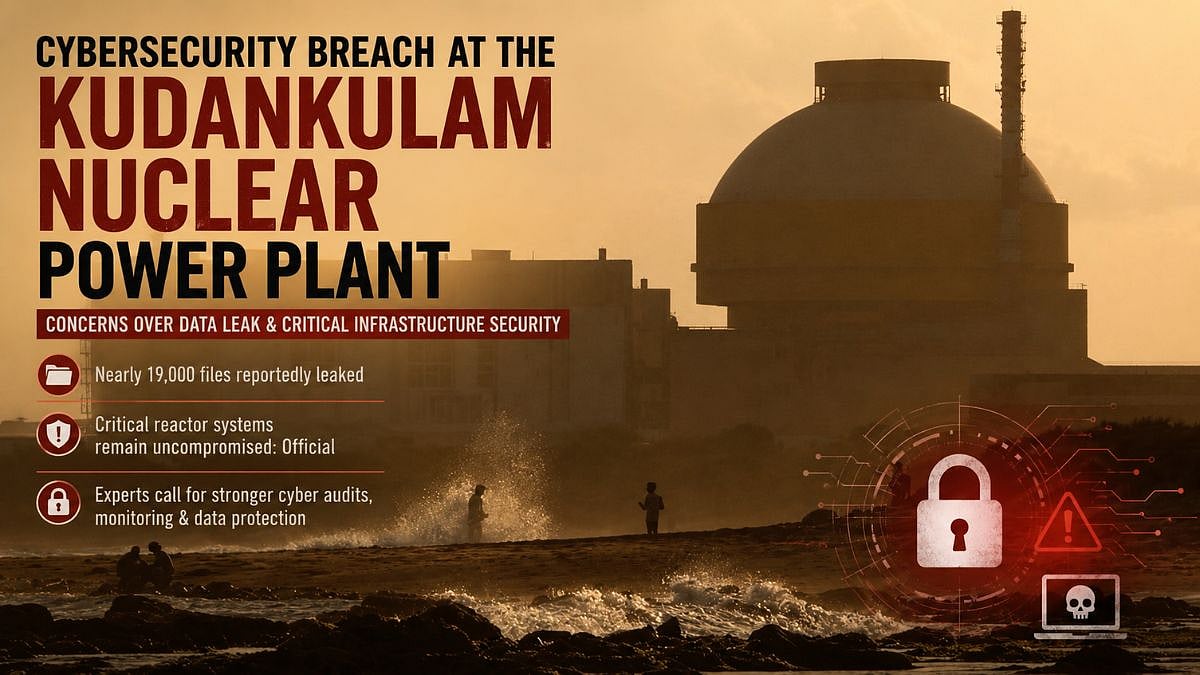
The reported data breach linked to the Kudankulam Nuclear Power Plant has renewed focus on cybersecurity safeguards for India's strategic infrastructure | AI Generated Image
The reported leak of nearly 19,000 files linked to the Kudankulam Nuclear Power Plant in Tamil Nadu should set off alarm bells across the country’s security establishment. Even if the authorities are correct in asserting that the plant’s critical operational systems remain uncompromised, the incident cannot be dismissed as inconsequential.
Nuclear installations are not ordinary infrastructure projects. Any breach involving them deserves the highest degree of scrutiny, transparency, and urgency. The official reassurance that the leaked files do not contain sensitive information relating to the reactors’ core systems is certainly comforting.
The reactors are supplied by Russia’s Rosatom, and there is no evidence that their operational controls have been accessed. Yet, such assurances answer only part of the question. They do not explain how a ransomware group managed to obtain as much as 14.3 gigabytes of data in the first place.
Nor do they establish with certainty that everything stolen has already been made public. Criminal syndicates dealing in ransomware are driven by profit, not publicity. It would be naïve to assume they have revealed every file in their possession.
Supply Chain Vulnerabilities
The breach reportedly originated from systems belonging to Reliance Infrastructure, a contractor engaged in the construction of Kudankulam’s Units 3 and 4, through servers hosted by a third-party data centre. This underlines a growing vulnerability in modern infrastructure projects. The weakest link is often not the principal installation but the extended network of contractors, vendors, and service providers.
A cyberattack on one partner can expose an entire ecosystem. Even documents that do not concern reactor controls may prove valuable to hostile actors.
Details about suppliers, layouts, support systems, contracts or insurance arrangements can help adversaries map vulnerabilities and identify points for future attacks. Cybersecurity experts have rightly warned that such information, when pieced together, can become an intelligence goldmine.
Need For Stronger Cybersecurity
The Kudankulam incident is also a reminder that India’s cyber preparedness remains inadequate. India ranks among the world’s worst-affected countries for data breaches, while surveys indicate that many organisations lack basic cyber hygiene.
This is hardly reassuring for a nation rapidly expanding its digital and strategic infrastructure. Equally worrying is that this is not the first cyber scare involving Kudankulam. Malware linked to a North Korean hacking group was detected on the plant’s administrative network in 2019.
While the operational systems remained unaffected then as well, repeated incidents point to persistent attempts to probe India’s critical infrastructure. The government must, therefore, treat this episode as a national security warning rather than a public relations challenge.
Every contractor handling strategic projects should be subjected to rigorous cybersecurity audits, continuous monitoring, and strict compliance standards. In the digital age, safeguarding critical data is as important as protecting physical assets. Information in hostile hands can be be as dangerous as weapons themselves.
RECENT STORIES
-
-
-
-
-