The New Kind Of Intelligence: Calm, Predictable, And Human-Centered
The evening, moderated by Autism Speaks U President Lestine Grace Saquilabon and faculty advisor Shannon Weiss, approached AI not as a disruptive force but as a potential source of calm. It was a conversation about technology that listens rather than commands, supports rather than dictates, and adapts to the individual rather than imposing rigid systems.

For millions of autistic individuals worldwide, daily life is shaped not by dramatic challenges but by the subtleties of unpredictability. A sudden shift in routine, unclear instructions, or unexpected sensory triggers can transform an ordinary task into an overwhelming moment. The numbers themselves highlight the scale of this reality. According to the World Health Organization, about 1 in every 127 people globally is on the autism spectrum (WHO). In the United States, the Centers for Disease Control and Prevention reported that approximately 1 in 31 eight-year-old children has been identified with autism. (CDC).
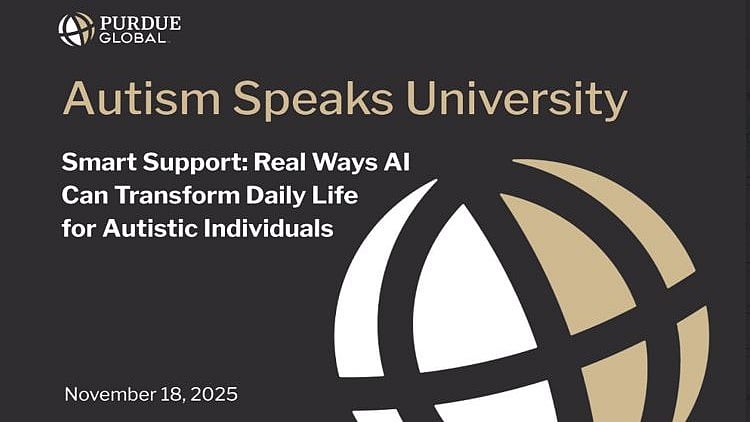
These statistics are more than data points; they are reminders of the need for tools that honor emotional safety, predictability, and independence. Against this backdrop, Purdue Global and Autism Speaks University hosted “SMART SUPPORT: Real Ways AI Can Transform Daily Life for Autistic Individuals” on Thursday, November 18, a virtual webinar that brought together ABA graduate students, parents of autism individuals, and community members closely working with children and adults with autism, shared questions:
Can artificial intelligence become a gentle, stabilizing partner in everyday life?
The evening, moderated by Autism Speaks U President Lestine Grace Saquilabon and faculty advisor Shannon Weiss, approached AI not as a disruptive force but as a potential source of calm. It was a conversation about technology that listens rather than commands, supports rather than dictates, and adapts to the individual rather than imposing rigid systems. She further added, “As President of Autism Speaks U at Purdue Global, my focus is on bridging the gap between autism awareness and innovation. I believe it’s time the tech and AI industries actively include neurodiverse voices. Our chapter is committed to raising awareness, educating our communities, and building platforms where individuals with autism, their families, caregivers, and therapists are heard and empowered.”
The collaboration with Ascend Ventures added another layer of intention to the event. Speaking about the partnership, Vasanthan Ramakrishnan, Founder and Principal Investor at Ascend Ventures, noted that “supporting neurodiverse communities is becoming essential to how future-forward organizations think about technology”. He reflected that the real promise of AI is not in its speed or scale but in its ability to reduce overwhelm and create steadier, more predictable environments for those who need it most.
As he described it, meaningful AI should feel less like a machine offering instructions and more like a companion that helps people navigate their routines with confidence and clarity.
A Shift Toward Human-Centered Intelligence
From the first minute, it became clear that the webinar was grounded in compassion rather than technical bravado. Weiss began by emphasizing that the mission of Autism Speaks U has always been rooted in awareness, education, and practical support for individuals with autism and their families. This event, she explained, was designed to illuminate how AI can reduce daily stress, improve communication, and make routines feel safer and more predictable.
Across the various speakers, one theme consistently surfaced: AI can only be meaningful when it creates clarity, reduces cognitive load, and respects the emotional rhythms of autistic individuals. That meant designing tools that explain their actions transparently, break tasks into manageable sequences, detect early signs of sensory or emotional overwhelm, and support communication differences without judgment or pressure.
There was an emphasis on independence, not the kind that pushes individuals toward rigid goals, but the kind that allows them to navigate the world with greater confidence. The conversations highlighted AI’s role in supporting executive function, stabilizing sensory environments, offering emotional guidance, and ensuring digital safety. Through all of these ideas, one belief was shared by everyone in the virtual room: AI should make life calmer, not more complicated.
This collective lens set the foundation for one of the evening’s standout sessions, the presentation by Manali Amin, whose perspective bridged technical precision with profound human sensitivity.
The Power of Predictability: Amin’s Framework for Meaningful AI
When Manali Amin began her presentation, titled “From Compliance to Compassion,” she did not approach the topic as a technologist eager to showcase tools. Instead, she approached it as someone who has spent nearly a decade in pharmaceutical validation and digital quality systems spaces, where clarity, structure, and user safety are not optional but essential. Yet her message was not about procedures; it was about people.
Amin opened with a connection that reframed the conversation. Although pharmaceutical systems and autism support may seem distant, she explained, both rely on the same core principle: predictability creates safety. In the pharmaceutical world, this protects the integrity of life-saving medicines. In daily life, it protects the emotional well-being of autistic individuals who often rely on stable routines and clear expectations.
Her talk was grounded in a simple truth: autistic individuals should not be expected to adapt to technology; technology should adapt to them. This meant designing AI that guides gently, communicates clearly, and never overwhelms or confuses the user. Amin emphasized that AI must support human decision-making, not override it. Transparency, she argued, is fundamental; users should always know what the system is doing and why.
As she walked through her presentation, Amin described the practical ways AI can support daily routines. She spoke about communication assistance AI that converts speech to text, simplifies complex language, or uses visual icons for those who experience language fatigue or processing differences. She discussed sensory-aware environments that adjust lighting or noise levels and detect early signs of sensory overload. She elaborated on emotional co-pilot systems capable of identifying subtle stress patterns and offering gentle, non-intrusive suggestions for regulation.
Amin also highlighted the role of AI in supporting executive function, breaking tasks into clear, manageable steps, helping users stay organized, and offering visual cues that make routines feel less overwhelming. Every example returned to the same principle: the goal of AI is not efficiency, but comfort. Not speed, but steadiness. Not control, but support.
Her conclusion was a quiet but powerful reminder: “AI is only intelligent when it respects the person using it.” It was this line that tied her entire vision together, a vision in which technology serves as a compassionate companion rather than a demanding system.
Why the Next Leap in AI Must Be Human
As the webinar wrapped up, it became evident that the future of AI in autism support will not be defined by the loudest innovation, but by the gentlest. The evening’s discussions, shaped strongly by Amin’s insights, revealed a blueprint for humane technology, one built on clarity, emotional safety, and respect.
For autistic individuals, AI’s promise lies in the subtle moments: a reminder delivered in a comforting tone, a routine laid out visually, a sensory trigger softened before it escalates, a task broken into steps that make the day feel navigable. These moments, while small, carry life-changing power.
The webinar also hinted at a broader future: one where AI helps autistic adults live independently, where digital environments are safer, where emotional patterns can be understood rather than feared, and where routines bring peace instead of stress. It’s a future shaped not by complexity, but by compassion.
If the most advanced AI of tomorrow succeeds, it will not be because it thinks faster than humans. It will be because it supports humans quietly, respectfully, and with unwavering clarity.
Published on: Monday, December 22, 2025, 03:50 PM ISTRECENT STORIES
-
-
-
-
-