'Centre Can Use Patent Law To Make Costly Life-Saving Drugs More Affordable': Kerala HC
The Kerala High Court has held that the Centre can potentially invoke Section 100 of the Patents Act to make patented life-saving medicines available to needy patients on a non-commercial basis. The Court did not order intervention in the case, saying the government must first collect data to determine whether a medicine is unaffordable.

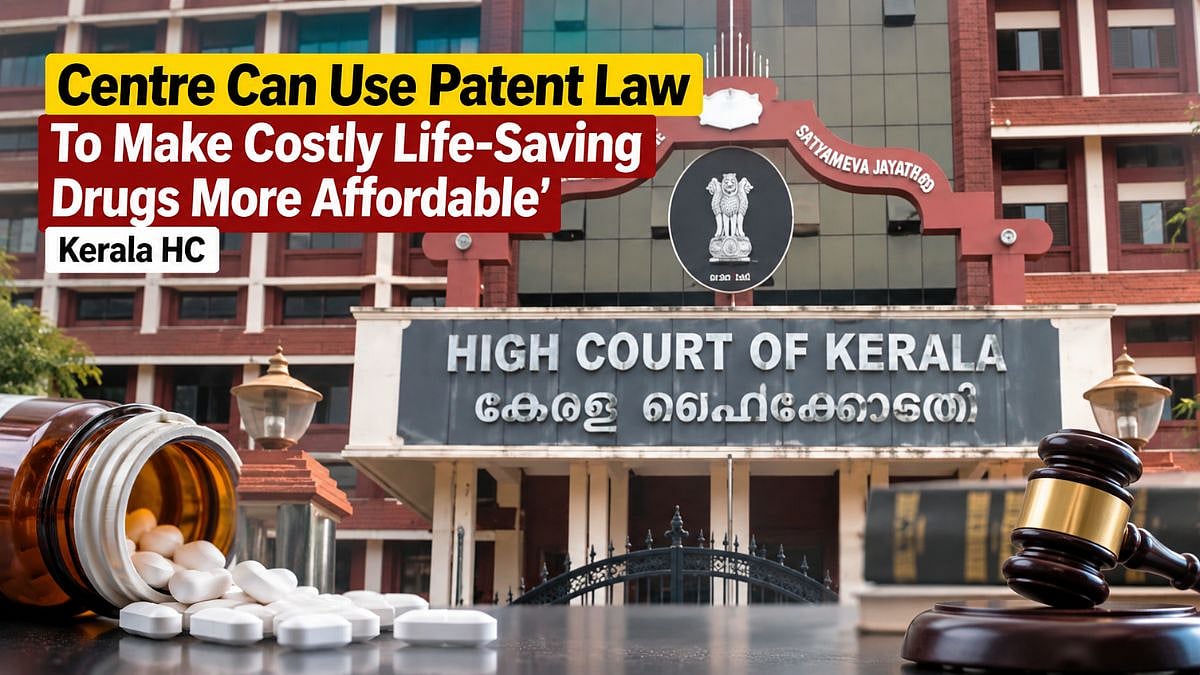
The Kerala High Court has left the decision on government intervention in patented drug pricing to the Centre | AI Generated Image
Kerala, September 28, 2026: The Kerala High Court has held that the Central government can invoke Section 100 of the Patents Act, 1970, to facilitate the manufacture of patented medicines and make them available to needy patients on a non-commercial basis when government intervention becomes necessary, including in cases where drugs are sold at exorbitant prices.
Justice Harisankar V Menon, who delivered the verdict in a suo motu case concerning the high prices of patented life-saving medicines, however, left the final decision to the Central government. The Court said invoking Section 100 was ultimately a policy decision and that the government must first collect sufficient data to determine whether a particular medicine is affordable, Live Law and Bar & Bench report.
What Section 100 Allows
Section 100 permits the Central government to authorise the use of a patented invention for government purposes. The High Court said this power could include using a patent to manufacture the medicine covered by it and selling the drug to a person, including a needy patient, on a non-commercial basis.
“Section 100 is required to be invoked in circumstances where the Government is required to intervene, such as an instance where the medicine manufactured on the basis of a patent is being sold at an exorbitant price,” the Court observed.
The Court, however, stopped short of directing the Centre to invoke the provision in the case before it. It found that adequate data had not been placed on record to determine whether the medicines concerned were affordable.
“It is for the Central Government to consider whether Section 100 requires to be invoked after collecting the necessary statistics,” the Court said.
The ruling puts the focus on a crucial balance at the heart of patent law: protecting innovation while ensuring that life-saving treatment does not become inaccessible solely because of its price. At the same time, the Court has placed responsibility for making that assessment on the government, based on evidence rather than directing immediate intervention in an individual case.
Case Began With Breast Cancer Patient
The proceedings originated from a petition filed in June 2022 by a breast cancer patient who sought affordable access to Ribociclib, a patented drug manufactured by Novartis.
The medicine was stated to cost around Rs 75,000 to Rs 78,468.75 a month. The petitioner sought the Central government’s intervention under the Patents Act to make the treatment more affordable.
The petitioner died in September 2022 while the case was pending. On September 16, 2022, the High Court decided to continue examining the issue as a suo motu case titled In Re Exorbitant Pricing of Life Saving Patented Medicines.
Advocate Maitreyi Sachidananda Hegde, who had represented the petitioner, was appointed amicus curiae.
Are Cheaper Drugs Really Alternatives?
A significant issue before the Court was whether Palbociclib, a breast cancer medicine whose patent had expired and which was available at a substantially lower price, could be considered an alternative to patented drugs such as Ribociclib and Abemaciclib.
The Court sought expert opinions from cancer institutions and the Drugs Controller General of India (DCGI). Based on those opinions, it concluded that Palbociclib and Ribociclib could not be treated as interchangeable.
Hegde argued that Palbociclib was not a substitute for Ribociclib and Abemaciclib because of differences in their uses and toxicity profiles. She submitted that Ribociclib was prescribed at an early stage of the disease, while Palbociclib could be used in metastatic stages.
The amicus argued that the unaffordability of patented medicines could affect patients’ right to health, particularly when early treatment could improve outcomes.
She also submitted that medicines accounted for only around 36% of the overall cost of treatment, which could include chemotherapy and surgery. Patients often had to borrow money or pledge assets to meet these expenses, she told the Court.
The Court was also told that there was no systematic scientific study detailing diagnoses and deaths for each type of cancer.
Women’s Access To Treatment Raised
The amicus also raised the issue of women’s access to healthcare, arguing that women’s health could take a back seat because they were often expected to make sacrifices for their families.
Referring to another patient who was subsequently impleaded in the proceedings, she said the patient could afford the medicine because of insurance, but her insurance claim had initially been rejected three times before being accepted. There was also uncertainty over whether the cover would be renewed.
Hegde argued that “government purposes” under Section 100 included non-commercial use and that, considering the purpose of the Patents Act and the public health implications, the Centre should intervene where necessary.
The Court was also told that two local companies had obtained Central Drugs Standard Control Organisation (CDSCO) approval to manufacture the drugs but had not applied for compulsory licences under the Patents Act.
Drugmakers Defend Patent Protection
Novartis, which manufactures Ribociclib, opposed government intervention and argued that Section 100 could not be invoked without first considering the compulsory licensing provisions under Sections 84 and 92 of the Patents Act.
The company submitted that Ribociclib was already subject to a capped trade margin of 30%. It also argued that invoking Section 100 without sufficient justification could adversely affect patent holders that invest billions in research and development.
Novartis maintained that arguments from a small number of people that a medicine was unaffordable could not, by themselves, justify intervention. It also stressed that patents served a public purpose because inventions eventually entered the public domain after patent protection expired.
Without patent protection, companies could have less incentive to disclose inventions and might instead protect them as trade secrets, it argued.
Eli Lilly, which manufactures Abemaciclib, similarly opposed intervention. It argued that there was no national emergency involving the three breast cancer medicines and said it offered schemes under which eligible patients could receive medicines free in certain circumstances.
The company also pointed to the time and money involved in developing new drugs and argued that patent protection was important for maintaining incentives for pharmaceutical research.
Both companies maintained that the Patents Act already sought to balance patent holders’ rights with public health considerations.
Centre Says Affordability Has Two Sides
The Central government argued that medicine affordability had to be considered from the perspective of patients as well as manufacturers.
It submitted that there was no single study establishing what price should be considered affordable or demonstrating that compulsory licensing would necessarily make a medicine affordable.
The Centre argued that competitive manufacturing could help bring prices down, but that this could require invoking Sections 92 or 100 of the Patents Act, which it maintained was not warranted in the circumstances before the Court.
The Department of Pharmaceuticals also highlighted the financial implications of manufacturing such medicines, including the cost of factories, machinery, raw materials and technical expertise.
The government further referred to Central schemes that provide financial assistance of up to Rs 15 lakh or help eligible patients obtain medicines free of cost.
Patients Point To Annual Cost
Lawyers representing the husband of the original petitioner and another breast cancer patient told the Court that the medicines could cost between Rs 7 lakh and Rs 10.8 lakh a year.
They argued that in the absence of affordable alternatives, the government had a duty to consider using the provisions available under the Patents Act.
Advocate Rahul Bajaj, who appeared in person as an intervenor, suggested that the Ministry of Health and Family Welfare develop a mechanism to determine how many people lack access to patented life-saving medicines.
Bajaj argued that the expression “government use” in Section 100 covered public, non-commercial use and pointed out that patent holders would still receive compensation where their patents were used for compulsory manufacture or non-commercial procurement.
He also submitted that while patent holders had property rights, the right to health had to receive due weight when the two interests came into conflict.
Data Must Drive The Decision
The High Court ultimately declined to order the government to invoke Section 100 for Ribociclib or other medicines involved in the proceedings.
Instead, it said the Centre should collect the necessary information and determine whether a particular medicine was affordable. If government intervention was found necessary after examining the data, Section 100 could be invoked.
Also Watch:
The judgment therefore does not itself make cheaper versions of the breast cancer drugs available. Its significance lies in clarifying that the government’s powers under Section 100 can extend to using patented inventions to make medicines available to needy patients on a non-commercial basis.
The ruling also underlines that affordability cannot be decided in the abstract. Reliable information on prices, access and patients’ ability to obtain treatment will be central to any future government decision to exercise these powers.
To get details on exclusive and budget-friendly property deals in Mumbai & surrounding regions, do visit: https://budgetproperties.in/
RECENT STORIES
-
-
-
-
-