After Pioneering QR Code Payments, Vijay Shekhar Sharma Wants AI To Become Every Shopkeeper’s CFO
Paytm is expanding its AI platform to help small businesses manage cash flow, invoicing, inventory, payments and marketing. The company has begun offering AI solutions to enterprise merchants and plans to monetise them through subscriptions and transaction fees, targeting India's 8 crore MSMEs.

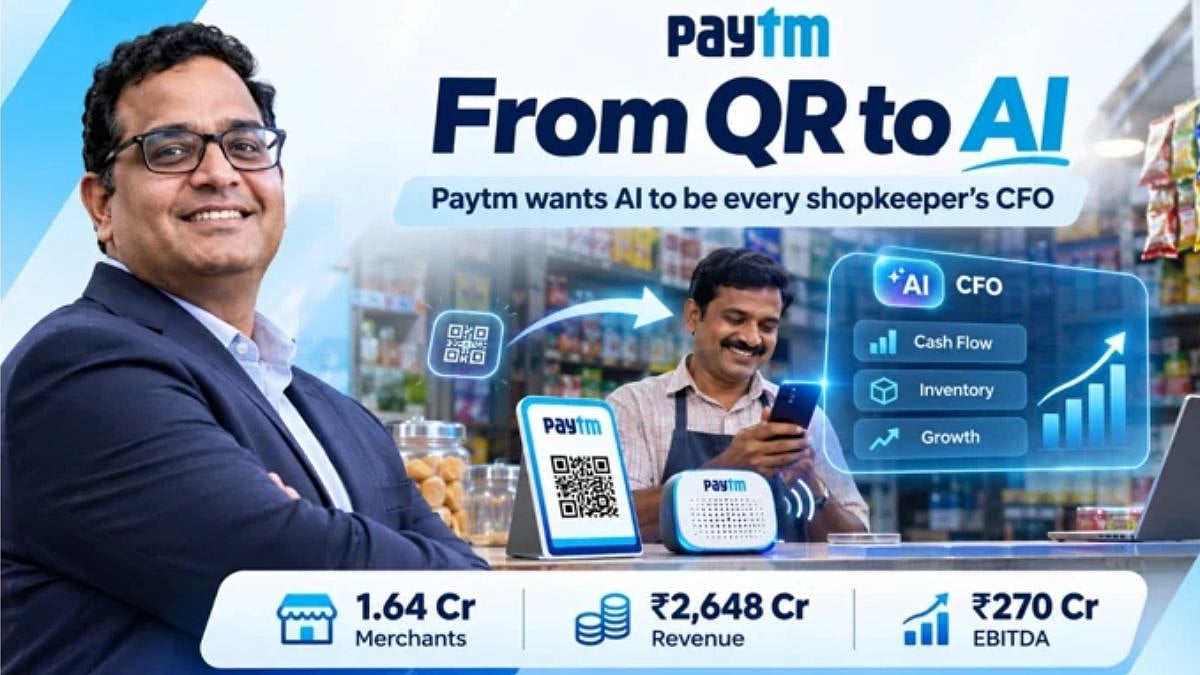
Paytm founder Vijay Shekhar Sharma is positioning artificial intelligence as the next growth opportunity for the company's merchant network, following its QR code and Soundbox expansion | File Photo
Vijay Shekhar Sharma spent a decade putting technology on the counters of India’s neighbourhood stores. First came the Paytm QR code, which let a kirana store accept money through a smartphone. Then came the Soundbox, which now sits at 1.64 crore storefronts. His next product for those shops is not a device. It is artificial intelligence that can do the job of a chief financial officer.
In its Q2 FY27 earnings release, Paytm said every merchant gets what only big businesses could afford: “a CFO to manage cash flow, invoicing, inventory and payments and a CMO to bring in customers and grow sales”.
Sharma explained the thinking on the company’s earnings call on October 27, 2026. Small businesses, he said, need “capabilities which large companies already have. And they don’t have somebody to operate it, so the AI operates on their behalf.”
The opportunity is large. India has about 8 crore MSMEs. They employ more than 30 crore people and contribute about 30% of GDP, according to MSME Annual Report data cited by Paytm. The company says AI-powered technology in payments and financial services has allowed it to serve these businesses profitably.
Last quarter, Sharma told analysts that Paytm would take the AI it built for itself to the market. “Once we’ve done it, we will sell it to outside people,” he had said. That plan is now in motion. Paytm has begun offering its AI platform to enterprise merchants. For smaller shops, the tools will earn through “subscription plus transaction fee, one of the two or both,” Sharma said. He added, “right now we are focused on creating agents for small businesses.”
That revenue will be booked under marketing services, which grew 26% year-on-year to ₹287 crore in the quarter. On when the AI business will show up in the numbers, Sharma said, “by the same quarter next year, we should look at what it has done.”
Paytm’s payments network gives it the distribution to sell these tools. Merchant GMV rose 26% to ₹7.1 lakh crore, and subscription merchants grew by 27 lakh over the year. Revenue from distribution of financial services jumped 49% to ₹912 crore, with more than half of merchant loan disbursements going to repeat borrowers. Sharma described the model in one line: “We acquire using payment. Credit is what earns our money. Insurance and wealth deepen, and AI binds.”
Even before selling AI to shopkeepers, Paytm has been running its own business on it. Choosing which merchant to sign up and which one to retain is now “decided by a machine, not just individuals,” Sharma said. “We are not renting intelligence from outside. We make our own models.” Group CFO Madhur Deora said that “instead of deploying it in three or four weeks, we’re deploying it in two or three days.”
The results show in the accounts. Revenue from operations rose 28% to ₹2,648 crore, EBITDA grew 90% to ₹270 crore, and profit after tax stood at ₹225 crore. Indirect expenses fell to 46% of revenue from 52% a year earlier. Revenue is now growing faster than costs, and Paytm credits AI for accelerating that gap.
Brokerages tracking Paytm are also watching the AI opportunity closely. Morgan Stanley said “Paytm has begun commercialising AI-enabled merchant solutions through subscription and transaction-linked fees.” JM Financial said marketing services, where Paytm will book its AI revenue, is “the likeliest venue for AI monetisation to surface first.” Nomura noted that “Management insists there is ‘zero drag’ and that AI spend pays back within the same quarter.” Haitong Securities said “AI-led product innovation is translating into market-share gains.”
As Sharma put it on the call, “Paytm changed the cost of serving a small business into a profit.” If the QR code taught India’s shopkeepers to accept money on a phone, Sharma is betting that AI will now help them manage that money and grow their business.
RECENT STORIES
-
-
-
-
-