‘If She Says No’: The Dangerous Rise Of Digital Misogyny Worldwide
A disturbing global pattern linking online misogyny to real-world violence has emerged, beginning with Brazil’s viral “if she says no” trend where men simulated attacks after rejection. Investigations also exposed massive online assault networks and leaked hospital CCTV footage of women. Together, these incidents raise urgent questions about safety, and where women can truly feel secure today

“How to kill a woman without trace” was searched millions of times online last year. Pause there for a moment. Sit with that sentence. Because while debates rage about whether women “overreact” to safety concerns, the internet itself seems to be asking darker questions, repeatedly, obsessively, and at scale.
And lately, those questions are no longer staying confined to search bars.
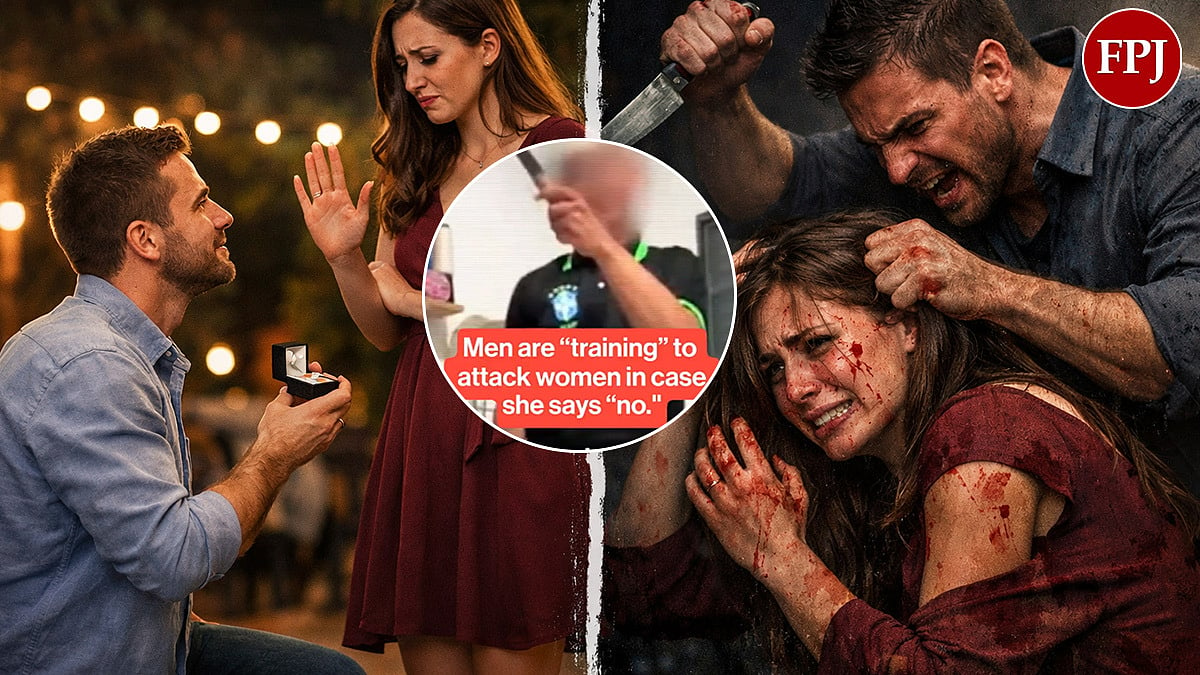
Across Brazil, a social media trend began quietly, almost absurdly. Men filmed themselves acting out exaggerated, fictional reactions to rejection. The videos were tagged under what became known as the “if she says no” trend. Some creators pretended to stab invisible partners. Others threw mock punches at the camera. A few pointed imitation guns while joking about what would happen if a woman refused them.
At first glance, it looked like another fleeting internet joke. The kind designed to provoke outrage and rack up views. But then reality intervened.
According to reporting by Brut America, 20-year-old Helena Anizio Rosak from São Gonçalo near Rio de Janeiro had rejected a man who had previously sent her flowers and chocolates. Weeks later, he allegedly broke into her home and stabbed her nearly 50 times. The attack stopped only when Helena’s mother intervened.
Helena survived, barely, after being placed in a medically induced coma and undergoing multiple surgeries. Her mother later said the attacker had consumed similar online content before the assault.
Suddenly, those videos stopped looking like jokes. Brazilian authorities have since opened investigations as clips circulated showing men attacking mannequins or imaginary figures while declaring, “I’m practicing in case she says no.” The line between performance and threat had blurred so completely that many viewers struggled to tell where irony ended and intent began.
“This is how normalisation works,” said a women’s rights activist (anonymous) when asked about the trend. “Violence doesn’t arrive loudly. It enters disguised as humour. People laugh first, then stop questioning.”
“Online radicalisation exposure rarely begins with overt hate. Instead, it grows through repeated narratives framing rejection as humiliation and masculinity as dominance. Algorithms reward the shock value. The audience grows. The message travels further,” she continued.
For many women, the impact is immediate and deeply personal.
“I already calculate routes home, share live locations, pretend to be on calls at night,” said Riya Shah, a 27-year-old marketing professional. “Now even saying ‘no’ to a guy I do not like feels like it carries risk. You start wondering, who is watching these videos and taking them seriously?”
The Brazilian trend might feel shocking enough on its own. But investigations suggest it is only one piece of a much larger digital ecosystem.
In April 2026, a CNN undercover investigation exposed what reporters described as a global “online rape academy” - hidden networks operating primarily through private Telegram groups and specific pornographic forums. It’s called motherless.com. Thousands of men allegedly exchanged detailed instructions on drugging and sexually assaulting women while avoiding detection.
The most disturbing detail was not anonymity, but familiarity. Many discussions centred on wives and girlfriends. Members shared advice on slow-dosing sedatives, manipulating wifes and girlfriends over time, and recording assaults while victims were unconscious. Videos circulated under coded labels like “sleep content,” verifying that women shown were incapacitated.
The scale of participation stunned investigators. One of the primary platforms linked to the so-called “online rape academy” recorded around 62 million visits in February 2026 alone, a number that surged to more than 81 million visits in March 2026. Internet always defends saying, “not all men” but is always a man! How do you consume these acts or reason with the fact that women are being hated for no reason. You go numb trying to understand the root cause of such thoughts.
“I feel that male loneliness epidemic is just a cover up for the new generation of men committing crimes and getting away with it, still putting the burden on women. The retaliation to feminism has always been extreme, from witch-hunting to online rape academies, patriarchy is so well designed it always repackages and upgrades itself,” says, Naksi - founder: Her.Autonomy & a law student.
“Women being public and empowering themselves has deeply threatened men and their position of power in the society leading to such heinous practices,” she added.
“As a man living in a male dominated society, it makes me sick to read such content and somehow feel guilty about the fact I am man! The guilt is not because I have done something, but because I belong to a race that has the capability to produce such heinous thoughts and even act on it. I am a man but also a feminist. Proudly! And I have my mother to thank for it. I don’t think I can bring great change to the world, but I can create an environment within my family where no woman has to think twice before fighting for herself and believing that her family has always got her back,” says Dheer Vira, a 29-year-old Mumbai artist.
And if this hasn't disturbed you until now, read this!
Separate cybersecurity findings have revealed hospital CCTV footage of women being leaked and sold as pornography online. In India and across the globe. Footage captured inside medical facilities, places built on trust, has reportedly surfaced on adult sites due to unsecured networks and weak digital protections.
A woman seeking treatment, unconscious or vulnerable, can still become content. Let that sink in for a minute!
Taken together, these stories do not feel isolated. They form a pattern, one that moves from viral humour to organised abuse to institutional failure. Each layer reinforces the same unsettling reality: technology has accelerated misogyny faster than accountability can catch up.
We often ask women to be cautious. Don’t walk alone. Don’t trust strangers. Don’t share too much online. But what happens when the threat is algorithmically amplified, privately organised, and silently recorded?
Perhaps the more honest question is no longer whether women are overreacting. It is this: if rejection can become entertainment, life partners are looking for ways to hurt you, and even hospitals cannot guarantee privacy, where exactly is a woman supposed to feel safe?
RECENT STORIES
-
-
-
-
-