‘It is time for Indian philanthropists to give attention and moral courage’
From founding GiveIndia and launching Daan Utsav to setting up India Welfare Trust, Venkat Krishnan is one of India’s earliest philanthropy pioneers. He talks to KAVITHA IYER on wealth, the generosity of the poor and inequality in the country

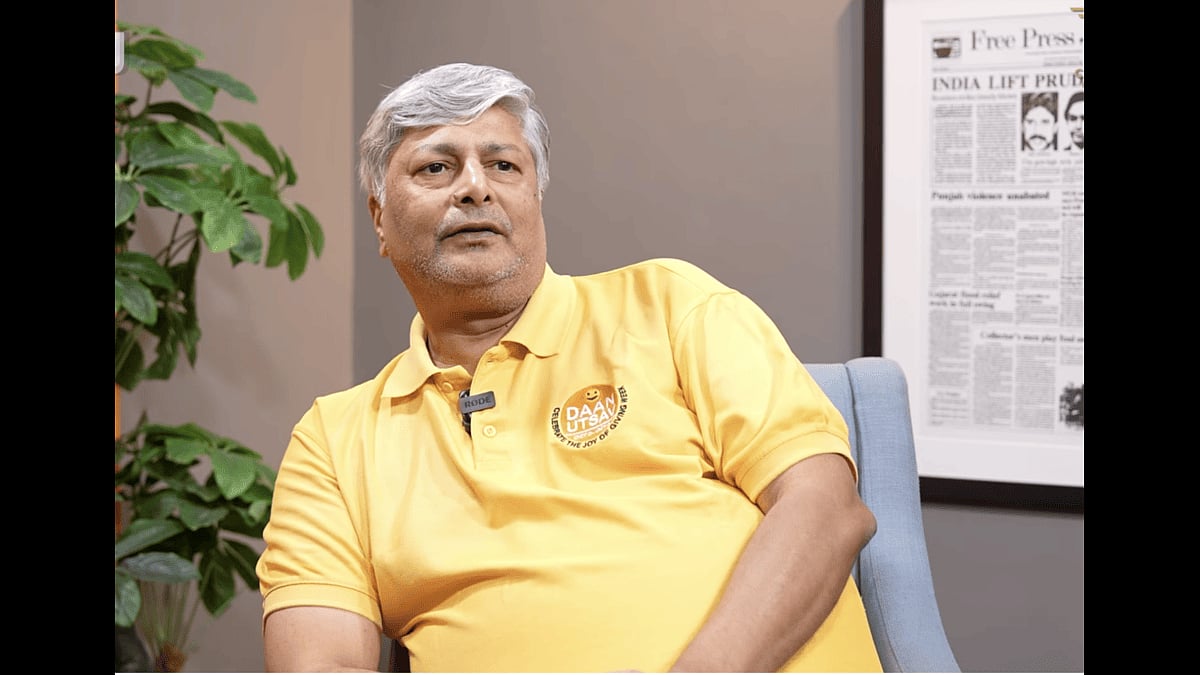
Venkat Krishnan |
You set up Give India more than two decades ago, when philanthropy was still in a nascent stage. What drew you to the sector?
Give India was more driven by a trip I made to the US in 1998. I was very curious to learn more about the US as a country. And I was still running Eklavya School in Ahmedabad, so I visited schools across the US, primarily public schools and one of the things that stood out, whether it was in all the schools that I visited, I’d see parents volunteering. Maybe coaching a hockey team or organising bake sales to raise money, etc. Everywhere I went, there was this strong undercurrent of caring and wanting to give back. That was missing in India.
I discovered that US giving at that point of time was a little over 2% of their GDP. There were no real figures available for India, but whatever little one could triangulate, from the revenue foregone reports the government puts out, our best optimistic estimate was about 0.08% or 0.1% of GDP. And this includes giving to temples.
I realized two things. One is, of course, a lot of my batchmates and all were doing quite well by that time and wanted to give back, but didn't know where to. Everybody had heard of only two or three organisations like a CRY or a HelpAge or UNICEF. On the other hand, there were thousands of nonprofits, many of whom I'd met, who were struggling to raise money and didn't know how to get the money.
Give India was a path-breaker, right? Among the world's first such initiatives?
We would have been in the world's first five or ten. Give India was set up between 2000 and 2002. The internet was beginning to take root and people were starting to think of all the different use cases for the internet. Matchmaking was the first and most promising use case for all internet donors.
The biggest success was being able to build a self-sustaining organisation that convinced donors that they should pay for the privilege of donating to organisations that they can trust.
What was the genesis of Joy of Giving Week, which was later renamed Daan Utsav?
In 2008, when I got out of Give India, the idle mind being a devil's workshop and all, a bunch of us got together at the home of one of Give India’s volunteers, and brainstormed about a National Giving Day. We started speaking to people, and instead of giving feedback to an idea that’s usually what happens, people proposed their own ideas around this idea.
The then head of ICICI Securities said she wanted to do an event where CEOs get together and raise money for a cause. My principal at Eklavya school said she wanted to get children to design solutions to social problems and run a campaign across the country. Rashmi Bansal, who used to run Jam Magazine, said she would reach out to colleges and encourage people to participate. In Chennai, a restaurant owner wanted to get all the five-star hotels in Chennai to organise a ‘battle of the buffets’ to raise money for a cause. I'd never seen ideas exciting people so much that they instantly had ideas of what they wanted to do.
Sachin Tendulkar, then at the peak of his career in early 2009, came on board as ambassador. We called it the Joy of Giving Week because the whole idea was we want people to experience the joy in giving.
On the morning of the press conference, Sachin walked up to me and said, "I can't tell everybody else to give when I'm not giving." He sponsored 200 children's education.
Eight months later, he hit his first double century. Two hundred children he was sponsoring, and he hit two hundred in the one-day international in Gwalior.
In the very first episode of the Joy of Giving Week, across the country, more than 50 cities and towns and lakhs of people participated. We raised more than Rs 20 crore in the first year.
When did it become Daan Utsav and why?
In Chennai, 30 auto drivers donated Rs 1,000 each, when they were on average making maybe Rs 6,000 a month. They fed 2,000 people. In Hyderabad, a group of auto drivers took 80 elderly citizens from old-age homes from Bhubaneswar to Puri for Jagannath darshan. The poor in this country are far, far more generous than we are.
When you stand at a chai tapri in Mumbai you’ll see the vendor give away free cups of tea to beggars, disabled people, etc. I once did an experiment standing and observing for over four hours—he was donating close to 3% of his total. And we make such a big fuss of companies giving 2% of profits before tax.
Between 2010 and 2012, it was clear that the poor in India wanted to be part of this festival, but none of them could pronounce ‘Joy of Giving Week’. So we came up with a name that was understandable across India. So in 2013, we finally changed to Daan Utsav.
Why are more wealthy Indians not giving as generously?
For Indians, giving is about taking care of your family, leaving something for your children's children and their children.
How do these reconcile? We just spoke about how Indians find this idea of Daan Utsav wildly popular. And on the other hand, those who have plenty are not more generous.
If an auto driver donates a thousand bucks, he's giving. If a billionaire gives a thousand bucks, is he giving? A lot of people who are very wealthy in India think that a few lakhs here and there given or a few crores here and there given is big.
I remember in 2010, one of our billionaires was on a television interview when his net worth was Rs 12,000 crore or Rs 14,000 crore. And they asked him, "Why aren't you giving more?" He said he was still insecure and that he’d be left with nothing if the business collapses. Seriously, anybody with a net worth of Rs 12,000 crore has at least Rs 1,000 crore saved or invested elsewhere. So even if you lose your business, you're still left with 1,000 crores. What the hell is wrong with you? Who is going to ask people these questions?
We continue to have a tax regime that hugely supports the amassing of capital by the rich, and we focus more on income taxes instead of taxing wealth. Wealth is the root cause of a lot of these problems. I know economists will argue that if you don't allow capital formation then how does growth happen, and maybe there is a right trade-off.
What if we, for example, removed income taxes altogether and just simply tax your wealth at 5% per year or 3%. It should be a small enough number to prevent capital flight, and we also need to make sure that the world gets together on this. Jeffrey Sachs has gone on record saying that we need taxes on wealth.
The other paradox is that if you have Rs 1 crore, you will earn 10 or 8 or 9% returns. If you have Rs 1,000 crore, you will earn 18, 20 or 25% returns. The more capital you have, the higher the rate of returns you get. So if you're giving 5% of your wealth away, your wealth is still growing.
Is there a case for philanthropists in India to give, after their money and time, moral courage?
The two most important things we need to do as people today are to give attention and to give moral courage. Attention to issues that simply we don't give enough attention to. A pop star or sportsman visiting Mumbai gets more coverage in our newspapers than the 2,500 deaths on the suburban railway every year.
Could it be that those who have power to give money do not have the power to give moral courage because their power depends on not speaking up?
The word courage loses its meaning if you say that I will be courageous only when there is no cost to me. Any situation where your action doesn't cost you anything is not courage. That's rubbish. That's convenience.
RECENT STORIES
-
-
-
-
-