When Citizen Accountability Turns Into Public Confrontation, Who Protects Due Process?
The CJP’s ‘School Thik Karo’ campaign highlights the need for public accountability, but citizen inspections must not become mob justice. The article argues that complaints about public institutions should follow due process, with officials investigated through lawful channels and courts, rather than instant verdicts driven by confrontations or social media.

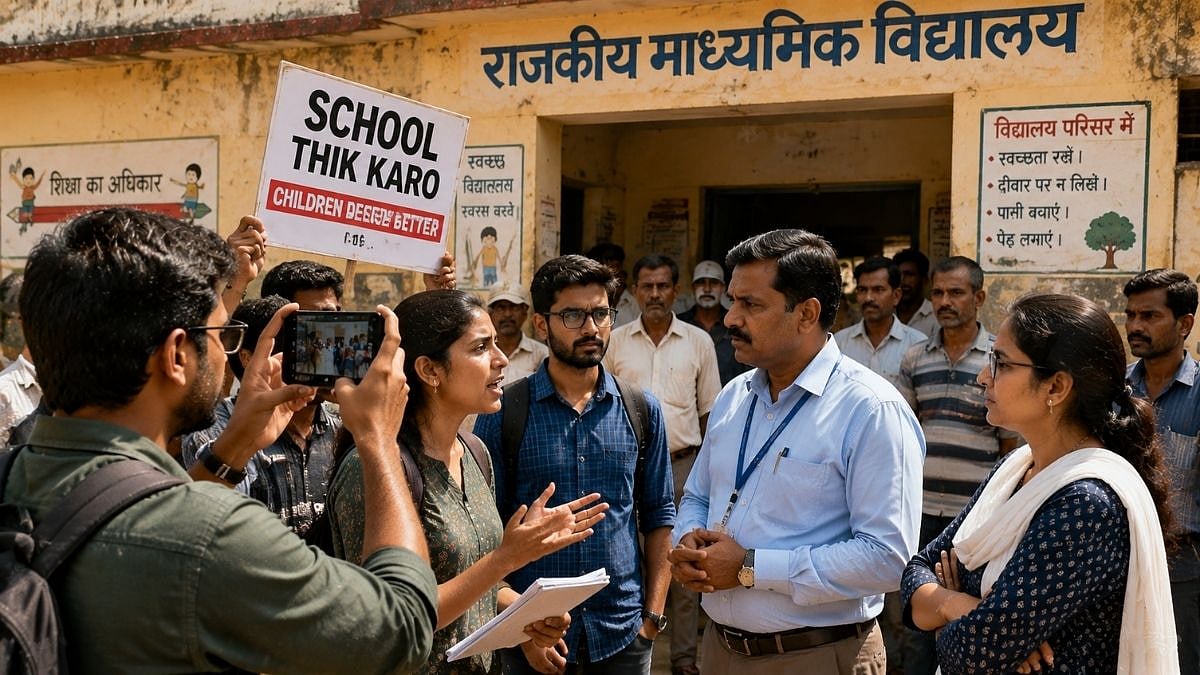
The article examines the fine line between holding public institutions accountable and allowing citizen activism to override established legal processes | AI Generated Representational Image
The death of Sheikh Mohammud Mafik, father of CJP volunteer Abdul Hafeez, who was part of the Cockroach Janta Party's (CJP) "School Thik Karo" campaign in West Bengal, should disturb every citizen, irrespective of political affiliation. Days later, on August 21, near Jaipur, another CJP team on the same mission was blocked and pushed out by villagers and alleged “BJP workers”, both sides trading accusations of assault and vandalism. This time there was no death, but the pattern is unmistakable, and it must caution us all.
From Vigilance To Vigilantism
This forces a hard question: can a legitimate demand for institutional accountability turn into mob accountability, where citizens armed with cameras and social media reach assume the roles of inspector, investigator, and adjudicator, all at once? "School Thik Karo" and campaigns like it are a genuine public concern. Government schools must have safe buildings, functioning toilets, electricity, water, and trained teachers if children are to learn with dignity. Citizens have every right to question the quality of public education; public vigilance is essential for healthy democracy.
However, the poor state of our schools is not simply a story of official apathy; it is, at root, a story of demand outrunning supply, worsened by how the available money gets spent. India's large population, which the CJP's own young "Gen Z" base also represents, places an overwhelming liability on public infrastructure, a formidable task even for a well-run state, compounded by the competitive populism of our political class.
The trade-off is visible: in the first ten months of 2025-26, states spent 68 per cent of their revenue budget on cash transfers, salaries, and pensions, while capital expenditure—the money that builds infrastructure, classrooms, and toilets—covered barely half of what was budgeted. RBI studies have flagged subsidies, now above 10 per cent of revenue expenditure in several states, warning that such sops "crowd out resources needed for development". West Bengal and Rajasthan, states now witnessing "School Thik Karo" confrontations, are among the more fiscally stretched. How a state balances demand against finite, freebie-depleted resources is quite a challenge. The answer cannot be a CJP inspection squad pronouncing judgement and confounding the problem.
Citizens Must Respect Due Process
There is a difference between being vigilant and assuming authority over an institution. CJP can seek information, document deficiencies, approach proper authority, invoke the Right to Information Act, petition representatives, seek judicial recourse, or protest lawfully. What CJP cannot do—however meritorious the cause—is become the judge to pronounce guilt on the spot. This distinction between vigilance and vigilantism separates a democracy governed by rule of law from one governed by the loudest crowd.
I say this having served four decades in public institutions. Institutions must answer to citizens, but public servants must also be allowed to do their jobs without unannounced "inspections" that can spiral into confrontation, public humiliation, or the fear that a selectively recorded argument will be circulated online as a verdict that can incite public anger.
I recall an episode from my alma mater, Sainik School Bijapur. An alumnus devoted to the school's welfare had taken to visiting the school often, sometimes unannounced. The principal wrote to the alumni association, acknowledging alumni contributions for the school, but explaining that unscheduled visits disrupted its discipline and defeated good intentions. The alumni understood; no confrontation, only an accepted correction, and the institution continued to function, undisturbed. That, to me, is a lesson in democratic citizenship: however genuine our concern for a public institution, it does not confer us the right to disrupt its functioning.
Public Institutions Need Rules
A public institution does not mean every part of its space is open to unscheduled audit by citizens. A government school is a public place where children learn and teachers carry out their duties, as are hospitals, museums, universities, offices, banks, etc., each with their own rules of access. Legitimising an idea that anyone can arrive with supporters, cameras, and phones and demand answers from whoever is present sets a dangerous precedent. Today it is a school. Where does it end?
The mobile phone is among the great democratising tools of our age; it lets citizens document wrongdoing. But it can also turn an encounter into a spectacle. A selectively recorded and edited clip may capture only a fraction of what transpired at the site; context vanishes, and the public often delivers its verdict before anyone has had a chance to explain.
Hear The Other Side
This is precisely why audi alteram partem—hear the other side—exists as a law to guard against: hear the accused before reaching a conclusion. It matters even more in the age of AI, when videos can be manipulated to incite public anger that can supplant our laws. It has a tendency to replace due process with instant digital judgement, and we risk destroying a reputation before the truth has even begun its journey through the law.
None of this argues against accountability, or in defence of negligent public servants. The CJP campaign's objective is praiseworthy; its means are not. Any official suspected of wrongdoing must be investigated and punished under the law if found guilty, but accountability must travel through an accountable process—let citizens question, institutions answer, agencies investigate, authorities discipline, and courts adjudicate.
Let self-appointed inspectors substitute for all of these school after school and sector after sector, and we risk normalising mob vigilantism in every sphere of public service delivery—the hallmark of a banana republic, not a constitutional democracy. Politics will then take over from process, and what began as a legitimate demand for better schools will end up eroding the very tenets of the democracy it claims to serve. We must be cautious of this path.
यतो धर्मस्ततो जय
Senior Advisor, CSMVS; Trustee, Gandhi Smarak Nidhi; and former Director, Nehru Science Centre, Mumbai, and NGMA, Mumbai.
RECENT STORIES
-
-
-
-
-