Merely Carving Out New Districts Is Not Enough, Ladakh Needs Structural Reforms
The creation of five new districts in Ladakh may improve administration, but critics say it does not address core demands for statehood, Sixth Schedule protections and elected governance. The move has revived debate over Ladakh’s political future.

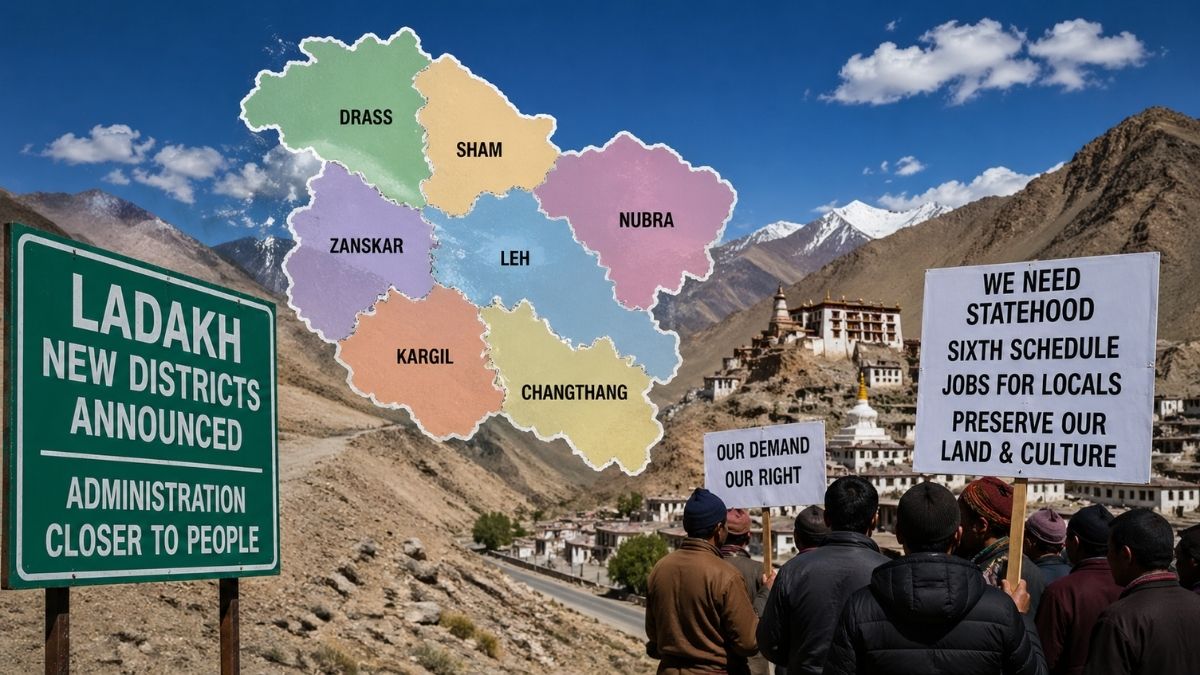
Ladakh’s new district plan has renewed calls for statehood, representation and stronger constitutional safeguards | AI Generated Representational Image
The decision of Ladakh’s lieutenant governor, Vinai Kumar Saxena, to carve five new districts out of Leh and Kargil, taking the Union Territory’s total to seven, has been projected as a bold administrative reform. The L-G, echoing the familiar cadence of Prime Minister Narendra Modi’s developmental rhetoric, claims it will bring governance closer to the people, generate jobs, and accelerate growth.
On paper, it sounds unimpeachable. In practice, it risks being little more than bureaucratic cartography, redrawing boundaries without addressing the deeper anxieties of a region that has simmered with discontent since 2019, when Jammu and Kashmir’s statehood was undone. For Ladakhis, the issue is not how many districts exist but who holds power.
Demand for real political power
Historically neglected under Srinagar’s shadow, the region once rallied behind leaders like Buddhist monk Kushak Bakula, who saw genuine autonomy as the antidote to marginalisation. Ironically, the reorganisation of J&K through the abrogation of Article 370 and its bifurcation into two Union Territories has replaced one form of distance with another.
Where elected representatives once mediated governance, it is now largely bureaucrats who call the shots. The absence of a legislative assembly has created a vacuum no number of new districts can fill. The unrest led by the Leh Apex Body and the Kargil Democratic Alliance reflects this reality. Their demands for statehood, safeguards, and representation are neither new nor unreasonable.
Sixth Schedule demand gains urgency
At the heart of the agitation is the demand for inclusion under the Sixth Schedule. With over 97 per cent of the population being tribal, Ladakhis seek constitutional protection for land, resources, jobs, and culture. The current Ladakh Autonomous Hill Development Councils lack legislative teeth; the Sixth Schedule would create Autonomous District Councils empowered to legislate on land, forests, and social customs as in Assam, Mizoram, Tripura, and Meghalaya.
Unlike the present arrangement under Article 240, which can be altered by the centre, the Sixth Schedule offers more durable safeguards. It is also seen as essential to preserving distinct identities, including languages such as Bhoti and Purgi, while ensuring that locals have a decisive voice in governance.
Economic and ecological concerns
Economic concerns deepen the unease. Despite high literacy, unemployment hovers around 26 per cent. The promise of jobs through administrative expansion rings hollow when locals fear being edged out by outsiders in a post-Article 370 regime. Now, anybody can buy land in Ladakh.
Environmental anxieties, articulated by activists like Sonam Wangchuck, add urgency. Unchecked tourism and industrial ambitions threaten a fragile ecosystem that cannot be managed through distant diktats.
Need for structural reform
Ultimately, new districts may offer marginal administrative gains, but they are no substitute for political empowerment. Ladakhis are not asking for more offices; they are asking for a voice. Without statehood and meaningful constitutional protection, such measures will remain cosmetic fixes for a structural problem.
RECENT STORIES
-
-
-
-
-