Ancient Skies, Endless Curiosity: Why Stargazing Continues To Captivate Human Imagination Across Centuries
From ancient scholars like Aryabhata to modern enthusiasts, stargazing has remained a timeless pursuit driven by curiosity about the universe. With simple tools and imagination, amateur astronomy continues to inspire wonder, offering perspective and connection across generations.

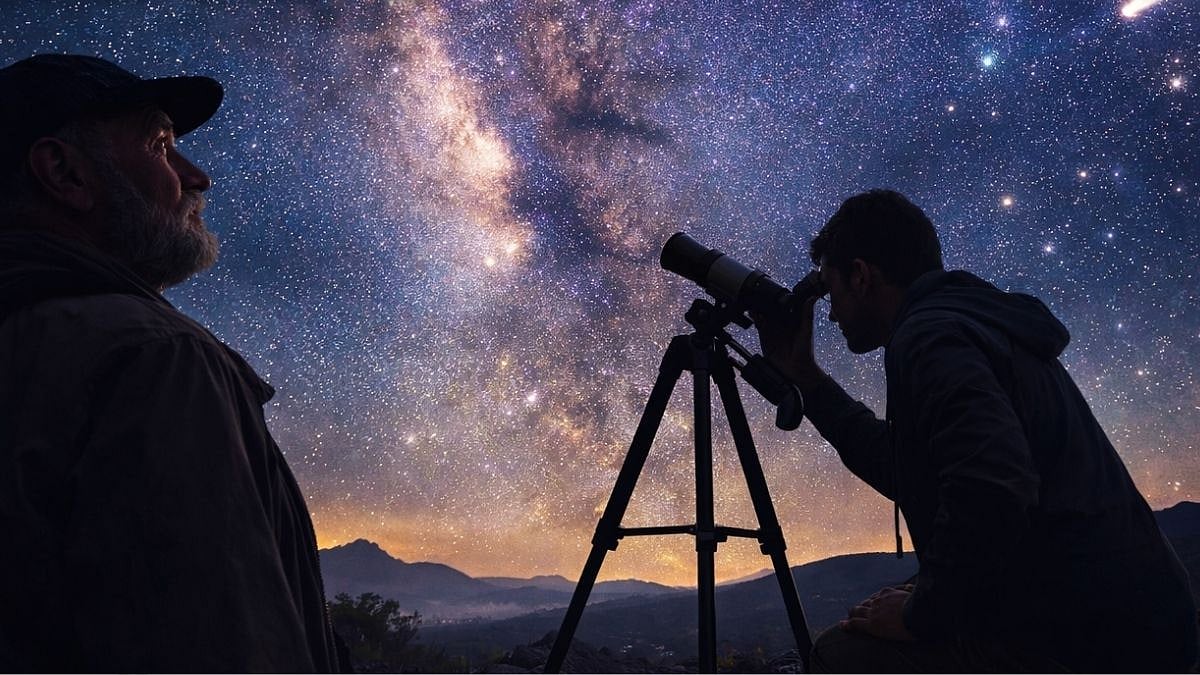
Stargazing continues to connect ancient wisdom with modern curiosity, inspiring generations to explore the cosmos | AI Generated Representational Image
Celestial bodies hanging like chandeliers in the sky have always fascinated professional astronomers as well as those who love star-gazing as dilettante or amateur astronomers, observed American astronomer and planetary scientist Carl Sagan, whose theories about the origin of the universe still hold ground.
Star-gazing is indeed a hobby that has a niche aura about it because it is one of the most absorbing pastimes for curious souls since time immemorial. In fact, professional astronomy became a proper discipline only a century ago. Before that, people used to observe celestial bodies with the naked eye, and those who could afford it would resort to binoculars or a cheap telescope.
Ancient references and early observers
The universe, sky, comets, stars, and all that have always made human beings inquisitive. There is a reference to this in the Mahabharata’s ‘Anusthaan Parv’, where Krishna predicted that a look towards the sky would one day open up a plethora of possibilities. The predominantly warrior Arjun could not understand the import of Krishna’s prophecy, but Bhishma did, remarking that the sky would continue to fascinate people in the times to come.
That is why Bhishma is often considered one of the earliest amateur astronomers.
Amateur passion through the ages
Star-gazing is a passion for those who want to know what lies beyond this visible world and are curious about the scope and extent of the boundless universe. Since this essay is by a casual astronomer for amateur astronomers, I do not wish to delve into the technical intricacies of the field. Instead, I focus on how amateurs have pursued this pastime through history.
Nearly 1,500 years ago, Aryabhata measured the distance of the Moon from the Earth and calculated the radius of the Sun without modern tools, relying on observation and mathematical insight. He was also among the first to distinguish between astronomy and astrology.
To quote Voltaire, “Superstition is to religion what astrology is to astronomy — the mad daughter of a wise mother.”
Arabs, Greeks, and Indians were among the earliest amateur astronomers who discovered many celestial phenomena. Scholars such as Ibn Battuta, Al-Battani, Al-Biruni, and Ibn Yunus made important observations without sophisticated instruments.
Babylonian astronomers like Hipparchus and Claudius Ptolemy also made foundational contributions, many of which remain relevant. Leonardo da Vinci, one of history’s most creative minds, often studied the stars through a basic telescope and drew artistic inspiration from them.
Modern amateur astronomy
We too can be amateur astronomers without joining any institute or learning complex techniques. A good pair of binoculars or a telescope is enough. All that is required is curiosity.
There are numerous amateur astronomical societies around the world that bring together enthusiasts. These groups organise meetings, talks, and observation sessions. In urban areas, activities may focus more on discussions due to light pollution.
Such societies also support niche interests like telescope-making and observational astronomy.
A call to look up
In an age of constant distraction, it is perhaps time to look up. Star-gazing offers both wonder and perspective.
As Jimmy Walker said, “The thing I like about astronomy is being outside at night and seeing the stars in a dark sky. It makes you feel small.”
Notable amateur astronomers include Sir Patrick Moore, Leslie Peltier, John M. Pierce, Tim Puckett, Russell W. Porter, Isaac Roberts, and Grote Reber.
So why wait? With simple tools and curiosity, anyone can take up star-gazing. Who knows, one day a star may even be named after you.
After all, astronomy is far more fun when you are not an astronomer.
Sumit Paul is a regular contributor to the world’s premier publications and portals in several languages.
RECENT STORIES
-
-
-
-
-