'Back To The Stone Age': What 3.4 Million Years Of History Says About Trump's Stone Age Threat To Iran
What is the Stone Age? From 3.4 million years of tool evolution to President Trump’s address on Iran, here is the link between history and the modern military strategy behind the quote

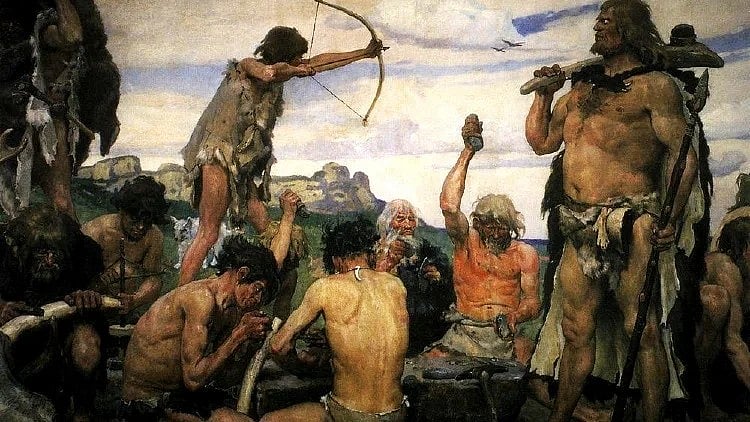
A painting depicting Stone Age | Inage courtesy Irfan2004/ Creative Commons Attribution/Wikimedia Commons
Long the domain of archaeologists and paleoanthropologists, the 'Stone Age' has been awakened from the pages of history and thrust into the centre of a global geopolitical firestorm. Following a high-stakes address to the nation on Thursday regarding escalating tensions in the Middle East, US President Donald Trump used the phrase to describe the intended impact of upcoming military operations. The remark has since triggered a wave of reactions ranging from diplomatic outrage and accusations of war crimes to significant fluctuations in global financial markets.
In his address, President Trump said, "Thanks to the progress we’ve made, I can say tonight that we are on track to complete all of America’s military objectives shortly, very shortly. We’re going to hit them extremely hard over the next two to three weeks. We’re going to bring them back to the Stone Ages very shortly, where they belong. In the meantime, discussions are ongoing.”
To understand the weight of this statement, one must look at what the Stone Age actually was and how its definition contrasts with the modern infrastructure currently being targeted.
What was the Stone Age?
The Stone Age marks a vast period of prehistoric history during which humans and their ancestors primarily created tools from stone, as well as bone and wood. It began roughly 3.4 million years ago and concluded with the advent of metalworking, typically between 4,000 BCE and 2,000 BCE, depending on the region. Researchers generally divide this era into three distinct stages based on the sophistication of tools and the lifestyle of the people.
Paleolithic Period (Old Stone Age): This is the longest phase, spanning from the earliest tool use until the end of the last Ice Age. During this time, humans lived as nomadic hunter-gatherers. They relied on "chipped" stone tools, such as hand axes and scrapers, to process food and skins. This era also saw the first instances of human expression through cave paintings and the controlled use of fire.
Mesolithic Period (Middle Stone Age): As the Earth’s climate warmed and glaciers retreated, human technology became more refined. This transitional period is characterised by the development of microliths—small, sharp stone flakes that were hafted onto wooden or bone handles to create spears, arrows and harpoons. Humans began to settle in more permanent camps and developed more complex social structures.
Neolithic Period (New Stone Age): This stage represents a fundamental shift called the Neolithic Revolution. People moved away from a purely nomadic existence toward agriculture and the domestication of animals. Technological advancements included polished stone tools, the invention of pottery and the construction of permanent settlements and megalithic structures like Stonehenge. The era ended as civilisations discovered how to smelt copper and tin to create bronze.
Modern context: Targeting infrastructure
While the historical Stone Age was a period of gradual human advancement, the modern use of the term in military strategy refers to the rapid deconstruction of a society. The current US air campaign in Iran has broadened to include the wider infrastructure like power plants, factories and the essential systems that allow a modern society to function. If all these get knocked out in this war as President Trump warns, Iran would literally find going bacl Stone Age with all modern infrastructure lying destroyed.
However, the use of this specific terminology has sparked a fierce backlash. The Council on American–Islamic Relations (CAIR) slammed the remarks as "anti-Muslim, racist, and dehumanising." The group argued that targeting civilian infrastructure is a war crime and urged Congress to pass a War Powers Resolution to investigate Defence Secretary Pete Hegseth—who echoed the President’s sentiment on social media—for potential war crimes.
Congresswoman Yassamin Ansari described the threat as a "vile, horrifying, evil" way to speak about a civilian population. Beyond the ethical debate, the rhetoric also had immediate economic consequences with markets falling globally.
In this information age, the very threat of sending a country to Stone Age crushes the very optimism if any for a peaceful resolution to the crisis.
RECENT STORIES
-
-
-
-
-