Sculptor Naresh Kumar Kumawat Is Bringing Slow Art Back Into A Fast-Scrolling India
As reels shrink attention spans, the Parliament muralist shows how monumental sculpture is finding new power and relevance in the digital era

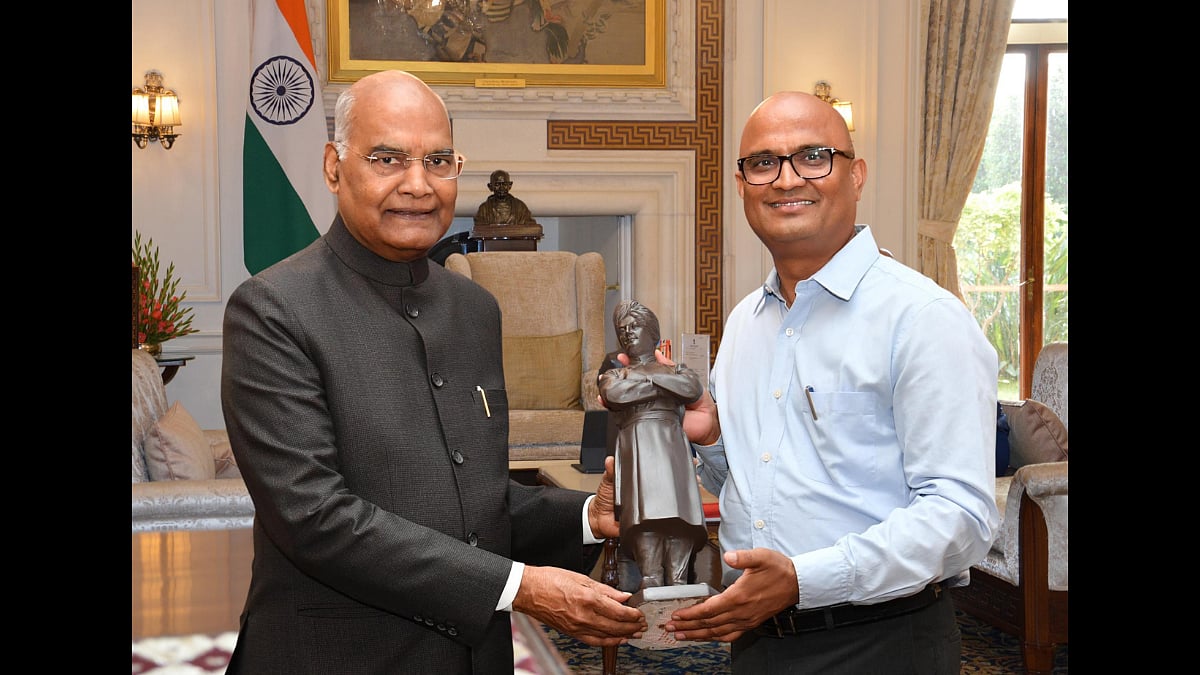
In 2025, when India consumes more digital content per capita than any other country, when Instagram reels dictate trends and attention spans shrink by the hour, it is almost ironic that one of the oldest art forms—monumental sculpture—is finding new life through the same digital ecosystem that threatens to overshadow it. Murtikar Naresh Kumar Kumawat, whose Samudra Manthan mural at the new Parliament stands among his most recognisable works, sees this paradox as not a contradiction but a creative opportunity.
“Earlier, sculptors had very few avenues to show their work,” he reflects. “Today, even a single post can reach thousands. The whole world is a gallery.”
It is a striking observation from an artist whose process is rooted in slowness, patience and contemplation. Monumental sculpture, with its scale, discipline and precision, is among the most competitive art forms in India. Recognition is subjective, pricing structures are fluid, and visibility is unpredictable. But in a country of over 150 crore people, Kumawat believes this very subjectivity can become an advantage. “Everyone has a different point of view,” he says. “That creates more opportunities than obstacles.”
At a moment when the digital world is becoming the most democratic exhibition space in Indian history, Kumawat is part of a generation of monumental artists navigating tradition and technology with surprising comfort and clarity.
Workshop to world stage
Kumawat’s journey began in the shadow of his father’s monumental work—most famously the 100-ft Shiva statue towering over NH-8. “From a young age, I knew I wanted to create something that would be remembered for years,” he says.
Growing up amid clay, chisels and stone dust, he absorbed technique the way most children learn language. Later, fine arts would give him structure, but the foundation had already been set in the workshop where monumental sculpture was both craft and inheritance.
Yet despite this deep-rooted traditional training, Kumawat would emerge as one of the more forward-looking sculptors in his field, someone who sees technology not as dilution but as expansion.
Tradition meets technology
As India accelerates its digital transformation, public art has evolved with it. The Ministry of Culture recorded a 31% rise in digital modelling in public art proposals submitted in 2024–25. Government bodies now use 3D scanning and CNC machining to scale prototypes faster. Laser printing and reverse-engineering software have become common across major sculpture studios.
Kumawat has embraced this shift without fear. “People think sculpting begins with carving,” he says. “But it begins with listening—to folklore, to the community, to the inner voice. Technology comes later. It’s merely a tool.”
In his studio, clay models are digitally scanned, refined in ZBrush or SolidWorks, and carved to monumental scale with extraordinary accuracy. Digital prototyping allows him to experiment freely, reversing or rebalancing structures that traditional carving would make irreversible.
“The artist’s touch remains the soul,” he insists. “Technology only gives freedom.”
This fusion of tradition and innovation reflects a larger shift within India’s young sculptors, who have embraced mixed media, kinetic forms and immersive techniques with enthusiasm. “Young artists are unafraid,” he says. “They’re combining mediums and creating works that move, breathe, and respond.”
Sculpting memories
Beyond technique, monumental sculpture remains a powerful carrier of collective identity. India’s penchant for large-scale public installations, from the Statue of Unity, which crossed 1.2 crore visitors this year, to city-level public art parks, signals a cultural appetite for memory-making in physical form.
Kumawat believes monumental art is uniquely positioned to carry this emotional weight. “A sculpture at this scale reflects shared consciousness,” he says. “It can unite people through history, belief and imagination.”
His own Samudra Manthan mural at Parliament is a testament to that idea: a mythological narrative rendered in stone, yet alive as a metaphor for India’s constant churn and renewal.
Slow art
But perhaps the most compelling element of Kumawat’s worldview is his belief that monumental art survives—and thrives—because it offers something the digital ecosystem cannot: slowness.
In a time when the average Indian consumes nearly 3 hours of short-form video a day, a 2025 Culture Ministry survey revealed that visitors spend four times longer engaging with sculptures than with digital screens or projections in public spaces. This surge in “slow engagement” has surprised policymakers, but not Kumawat.
“Sculpture slows the mind,” he says. “It demands attention, focus, depth. It rehumanises a person who may otherwise feel lost in the rush of modern life.”
This is where his philosophy becomes both artistic and political. In a world addicted to speed, he sees monumental sculpture as a counterbalance—a quiet rebellion against shrinking attention spans.
“Fast consumption doesn’t challenge the mind,” he says. “Sculpture makes you pause. It asks you to see differently.”
The future, carved gently
When asked what sculpture he would create to define India in the digital century, Kumawat imagines a form where tradition and innovation stand together. He speaks of a contemporary Bharat Mata surrounded by motifs of renewable energy, digital connectivity, and youth empowerment—a symbolic embodiment of “Sabka Saath, Sabka Vikas, Sabka Vishwas, Sabka Prayas.”
“It would reflect who we are,” he says. “Ancient wisdom and modern ambition, side by side.”
ALSO READ
As younger sculptors explore mixed media, coding, AI-mapping and kinetic engineering, Kumawat remains anchored in something timeless: intention.
“My only advice is to remain honest and reflective,” he says. “If the intention is pure, the artist’s voice will always shine—no matter what tools are used.”
RECENT STORIES
-
-
-
-
-