Charcha Time: Is India Becoming Nepal 2.0 Amid Rising Youth Anger & Online Outrage?
Alleged courtroom comments describing unemployed youth as 'parasites' and critics of institutions as 'cockroaches' spark social media fury, parody campaigns and a sharp debate over whether India’s Gen Z anger signals a real political shift or remains digital activism, even as the judge later clarifies his statement

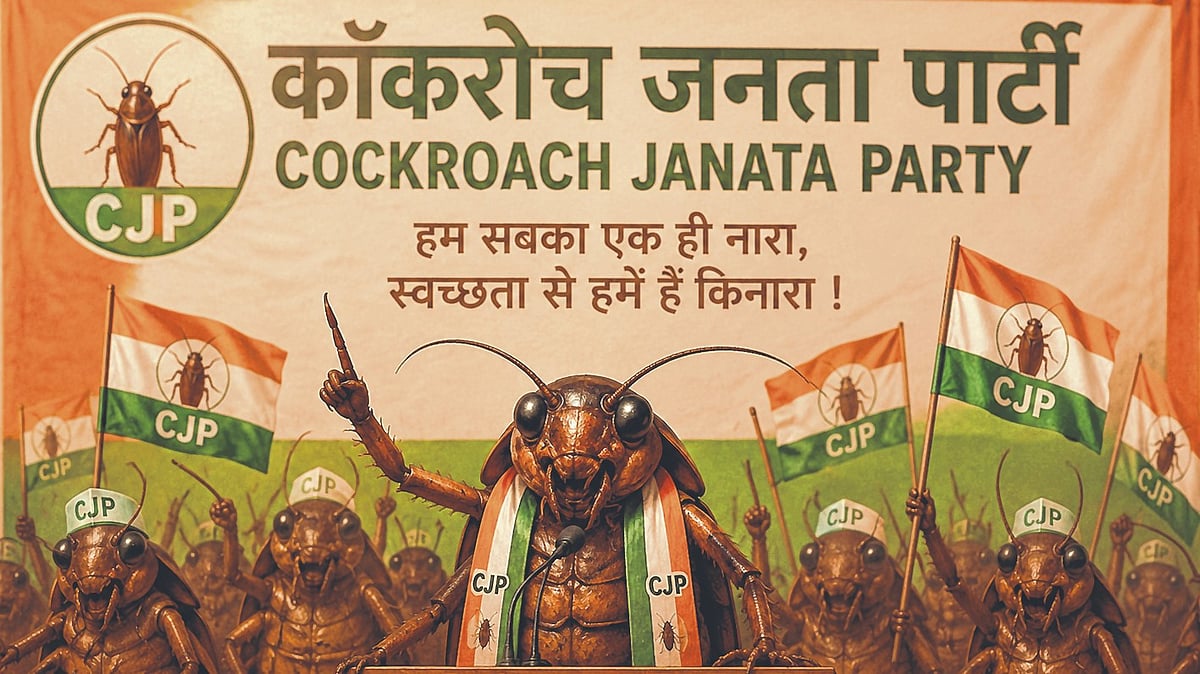
On May 15 2026, the Chief Justice of India commented on the unemployed youth of India and called them a parasite. He even went ahead and equated the RTI activists and press as roaches. This created a great storm of rage amongst the youth of the country. They took out their anger on social media, which created fury. A parody account, Cockroach Janata Party, has also been made across social media platforms to criticise and joke about the statement. Looking at the frustration and anger, the CJI took back his statement and clarified what he meant. The controversial statement was made during a court judgement. The anger of the younger generation reminds us of the recent uproar that happened in Nepal. Minal Sancheti speaks to people from all walks of life to understand whether this will be a similar case to Nepal and Sri Lanka.
Geeta Menon, Joint Secretary, Domestic Workers' Rights Union
This is not a movement. It is a spontaneous reaction to the frustration over all the issues related to unemployment, including the lack of attention paid to their education, as seen in the recent NEET case. Now the youth are treated like slaves. No attention is paid to the youth. And they are called upon to do big things for the country. The basic youth has no standard of living and nothing to go by. They have so many responsibilities and are called upon to take on more responsibilities. At the same time, the elders show no responsibility. All the people who talk about the youth and their power are the adults who are misusing the power themselves. In my opinion, you don’t call it Nepal 2.0 because if you see the Nepal movement, the whole rebellion by the youth is based on the political party foundation; they are political leaders, and there is politics. So you cannot term it as Nepal 2.0. It's a good thing that is happening. It’s a reaction, and it won't be able to sustain itself on the ground. On social media, people are showing their angst, and it is mostly the middle class. So it cannot become a political party. The Nepal youth rebellion is of a totally different context. It is a context that is built upon a political movement.
Dr Mugdha Dhananjay, Managing Trustee, India Study Centre Trust
Gen Z has the capacity, but whether it will bear fruit, I don’t know. I want to hope, though. Too many distractions and temptations could drive them away from the goal. Let’s see after they set the goals as their political agenda. CJI’s comments have definitely created a small storm, an awakening, an angry response. Whether it will mature into a political awakening is unclear. The film industry and the journalism industry’s paid agendas are major hindrances and hurdles in the way of Indian youth. Overall, people who want basic livelihoods can be bribed easily.
Abhay Deshpande, Political Analyst
In 1977, the Janata Party movement started, and all were youngsters who participated. This is not the first time it has happened. Jay Prakash Narayan, in 1977, gave that call for the national party, an agitation against the Congress government. That time, the youth were the main force behind the Janata Party movement. So this is not happening for the first time. Youth are awakening only on social media. I can’t see that kind of anger in the youth today. They are commenting and reacting to it, but this is not like Nepal and Sri Lanka kind of agitation because economically we are not in that bad shape. The reason behind the economic crisis is not the situation right now. They are active on social media, and social media activism is a temporary phenomenon. But definitely because of their reaction, the CJI corrected himself the next day. The youth are reacting and are more politically aware. If you see the AAP movement in Delhi, the youth were the main force.
Krishna Subramanian, Corporate Professional
CJI’s core frustration—frivolous litigation, questionable qualifications, and coordinated attacks on the judiciary—is understandable and even valid. But the delivery was clumsy, and the clarification feels like a tactical retreat rather than a pure “media misquoted me” correction. Judges, especially the CJI, carry an extra responsibility for measured language; oral remarks travel far and shape public trust in institutions. I also feel this episode ultimately reflects a deeper tension: the judiciary’s unfortunate need to defend itself from the public’s legitimate right to criticise it, as opposed to acting or noting the same. They were never asleep. Are awake and well. The CJI’s comment was wrong and should be condemned. India will never become Nepal. We will remain a healthy democracy.
Drishti Solanki, Junior Associate, Yasmin Bhansali & Co., Advocates and Solicitors
India’s youth today appears far more aware, expressive, and actively involved in public conversations. Rather than blindly following narratives, young people increasingly seek reasoning, transparency, and authenticity. Gen Z, especially, is vocal and quick to react when they perceive unfairness, whether in social issues or broader discussions. This growing engagement reflects a generation that wants to contribute and shape conversations that matter. However, increased awareness or public discourse should be viewed as a sign of democratic participation and evolving civic consciousness, rather than being reduced to comparisons with any other country’s journey.
Aarya Sawant, LLB Student
The Gen Z of India is frequently stereotyped as being constantly distracted, caught up in reels, trending topics and internet outrage. However, 2026 seems to prove this assumption false. In matters of employment, free speech, accountability and politics, Indian youth are more questioning than ever before. Recently, an episode involving the Chief Justice of India, Surya Kant, and his comments on youth unemployment led to a wave of protests.
The response from the younger generation can be viewed in a political and cultural context. This incident highlighted the long-felt anger and frustration of today’s youth in India, who are highly educated and politically conscious but are financially insecure. Therefore, the statements made by a constitutional authority concerning such a generation are inevitably politicized. At the same time, it should be noted that later on, CJI Surya Kant clarified that his criticism referred not to the youth in India as a whole, but to those having fake degrees and abusing institutions.
However, the spillover effects are genuine. The controversy was made social media fodder, meme material, debate topics, thought pieces and even a political rallying cry. The younger generations saw these remarks as a product of elitism and insensitivity towards reality, or that they were selectively taken out of context to rile up social media users. Even the Reddit discussion itself exemplifies the generational division within young Indians some supportive of the systems, others criticizing the system.
This, however, begs the question, Is this making India “Nepal 2.0”? Such an analogy sounds farfetched. Nepal's political instability has occurred due to completely contrasting historical and political backgrounds. India isn’t experiencing an institutional breakdown; rather, it is seeing an increasingly vocal generation calling for inclusion. India’s Gen Z population has stopped being blindly nationalist, blindly anti-institution and politically dormant. Instead, it has become cynical, outspoken and perpetually online.
The more relevant point here, however, is not about whether the youth is awakening; they have already done so. Rather, the real issue is whether the institutions, the political establishment, and the older generations are prepared to deal with a youth who will no longer be silent. It may appear that Gen Z in India is mocking through memes and sarcasm, but their message is very clear.
Sherene Zyda, Gen Z
It's funny how people think that traditions should be followed when the same traditions are broken by them. You can't worship goddesses and beat your wife at the same time. You do not know love if you don't believe that the same sex can love as well. These same people run our country. And when the youth tries to bring uplifting mindsets, we suddenly become parasites that wish to destroy the culture's traditions. These old adults will never understand what we want, let alone the nation.
Abhishek, Vissapragada, Author and PR Professional
Cockroach Janata Party or CJP was created by one of the guys who is based out of the US and is a former AAP party worker. But he created it as a joke because the CJI commented that all the unemployed youth are cockroaches. So CJP is a satire on the political situation in India. He never expected it to be such a big movement. Everyone following CJP knows that it is just a joke. This will not turn into anything serious on the ground like Nepal. That is because the Indian Gen Z is a lot more sensible that way. They won’t resort to absolute violence as happened in Nepal. There are a lot of systems in place in India where they can raise their voice and bring changes in society. Those systems are still in place.
RECENT STORIES
-
-
-
-
-