CBSE Issues Advisory On QR Code Misinterpretation After Orry-Linked Confusion In Class 12 History Exam
CBSE has issued an advisory clarifying that QR codes on question papers are not web links after a viral incident linked to Orry. The Board said such search results are unrelated and urged stakeholders not to share misleading claims.

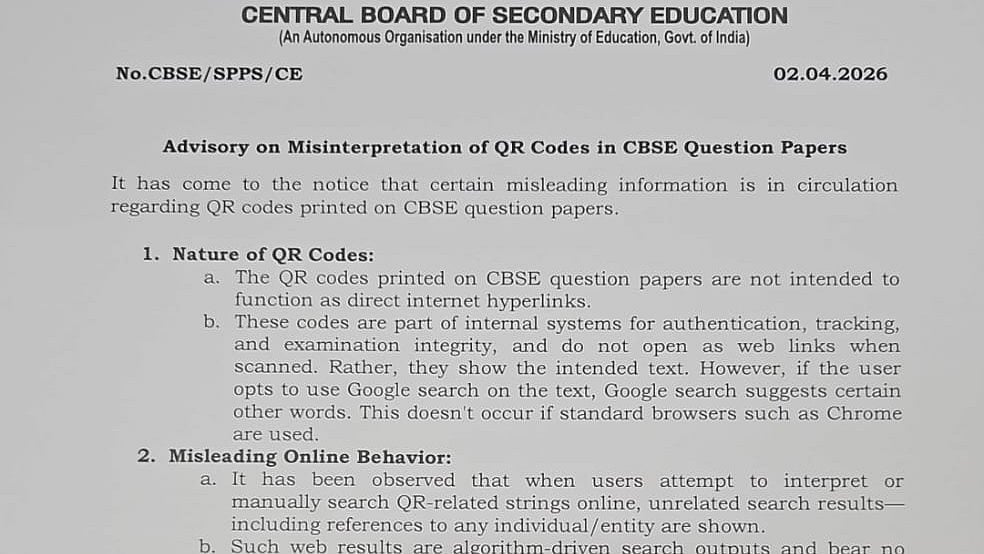
New Delhi: The Central Board of Secondary Education (CBSE) has issued an advisory addressing confusion and misinformation surrounding QR codes printed on its question papers, following recent incidents that went viral on social media, including one involving internet personality Orry.
The advisory, released on April 2, 2026, comes days after students appearing for the Class 12 History examination on March 30 reported that scanning a QR code on the question paper led to search results linked to Orry, triggering widespread online reactions and memes.
The videos of the students scanning the code and landing on unrelated internet content have gone viral on social media, making the usual inclusion of the code in the question paper a topic of discussion outside of its usual purpose.
QR codes meant for security, not external links
In its clarification, CBSE emphasised that the QR codes printed on question papers are not intended to function as internet hyperlinks. Instead, they are part of internal mechanisms used for authentication, tracking, and ensuring examination integrity.
The Board explained that when scanned, the codes may display text. However, if users attempt to search this text online, search engines can generate unrelated results, which has led to confusion in recent cases.
Board flags misleading interpretations
CBSE found that certain persons have been trying to link the results generated by the QR code to unrelated persons and content, including the recent claims made about Orry.
It has been clarified that the results generated by the QR code have no relation to the CBSE or the examination process. Certain aspects have been intentionally misrepresenting the results generated by the QR code to create false narratives.
Advisory to students, parents, and media
CBSE has urged all stakeholders, including students, parents, and media, to be responsible while disseminating information.
CBSE advised:
• Not to circulate unverified or speculative claims
• To rely only on official communication for clarification
• To avoid amplifying misleading or unrelated content
Maintaining trust in examination system
CBSE reiterated that QR codes form a part of its internal security measures and in no way affect the sanctity of the exam.
The advisory was issued by Controller of Examinations Dr. Sanyam Bhardwaj, emphasising the importance of sharing information responsibly, especially during the exam season.
The Board said that maintaining trust in public institutions depends on ensuring that only verified and factual information is circulated, even as isolated incidents like the viral QR code incidents continue to draw attention online.
RECENT STORIES
-
-
-
-
-