SCO Bishkek Declaration: India’s Strategic Balancing Act Gets Tougher
The SCO Bishkek Declaration gives India a stronger diplomatic platform on terrorism, including specific reference to the Pahalgam attack, while exposing challenges over Iran, Ukraine and sovereignty. India's engagements with Russia, Iran and China underline its strategic autonomy as it seeks greater influence in Central Asia, connectivity, energy and Eurasian affairs.

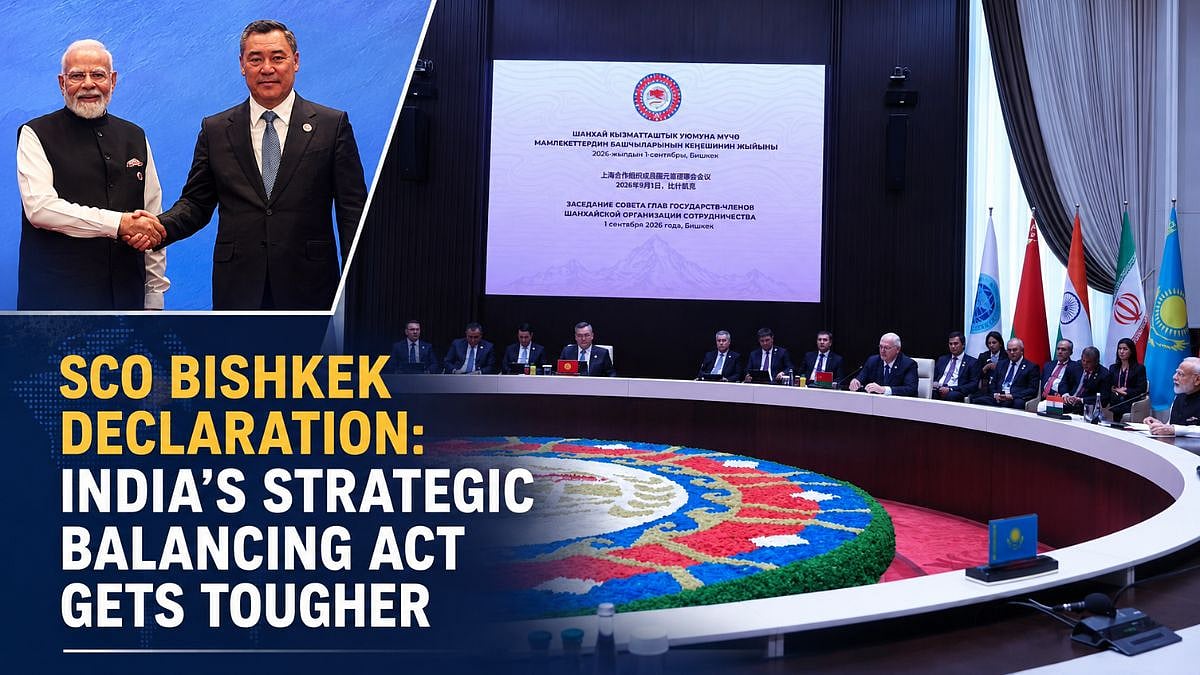
Prime Minister Narendra Modi's SCO engagement reflects India's effort to maintain strategic autonomy while navigating competing global interests | AI Generated Image
The Shanghai Cooperation Organisation’s Bishkek summit has produced a declaration that is significant for India not simply because it condemns terrorism or refers specifically to the Pahalgam attack, but because it exposes the increasingly complex geopolitical choices confronting New Delhi. The SCO’s 25th anniversary summit brought together India, China, Russia, Iran and Pakistan at a time when West Asia is in turmoil, the Ukraine war continues and the international system is becoming increasingly polarised. Its Bishkek Declaration reflects these contradictions: it strongly defends Iran’s sovereignty, opposes unilateral sanctions and condemns terrorism without double standards, while avoiding a direct condemnation of Russia over Ukraine. For India, this is both an opportunity and a diplomatic balancing challenge.
Special mention of Pahalgam Terror attack is a Diplomatic Gain for India
The most important gain for New Delhi is the declaration’s language on terrorism. SCO leaders condemned terrorism in all its forms, rejected double standards and called for dismantling terrorist financing, recruitment, radicalisation and safe havens. More importantly, the declaration specifically referred to the April 22 Pahalgam attack, expressed condolences to the victims and called for those responsible to face justice. This gives India a stronger diplomatic platform to underline its contention that terrorism cannot be divided into “good” and “bad” terrorism according to political convenience.
Prime Minister Narendra Modi sharpened that argument by telling the summit that terrorism remains a grave challenge to humanity and that countries using terrorism as an instrument of state policy cannot be allowed to treat it as a strategic asset. Though Pakistan, represented by Prime Minister, Shehbaz Sharif, presented itself as a victim of terrorism, the exchange demonstrated India's determination to keep cross-border terrorism at the centre of the SCO's security agenda. The significance lies less in the immediate political confrontation with Pakistan than in India's success in embedding its anti-terrorism concerns in the collective language of the organisation.
Iran and the Contradiction of Sovereignty
Yet the declaration also reveals a major contradiction. The SCO reaffirmed sovereignty and territorial integrity as fundamental principles while strongly supporting Iran in the conflict with the United States and Israel. It condemned military attacks on Iran and opposed unilateral coercive measures and sanctions. It also backed Iran's right under the Nuclear Non-Proliferation Treaty to pursue peaceful nuclear energy. But the same declaration did not condemn Russia's invasion of Ukraine. This selective application of the sovereignty principle is not accidental. It reflects the political reality that the SCO is a coalition of countries with overlapping interests rather than a unified strategic alliance.
For India, the Iran language is particularly important. New Delhi has traditionally opposed violations of sovereignty and unilateral coercive measures, but it also maintains close strategic and economic relations with the United States. The Bishkek Declaration therefore puts India in a delicate position. India can endorse the general principle of sovereignty and peaceful nuclear cooperation without becoming part of an anti-American bloc. Its diplomatic vocabulary of dialogue, restraint and negotiated settlements allows it to maintain relations simultaneously with Washington, Moscow and Tehran.
Modi’s Message: Dialogue Over the Battlefield
Modi's own intervention was consistent with this approach. He argued that the West Asian conflict had demonstrated that no regional conflict remains confined to its original geography because energy security, maritime trade and global supply chains are interconnected. His assertion that tensions must be resolved through dialogue and diplomacy rather than the battlefield was therefore not merely a statement about Iran. It was a restatement of India's broader foreign-policy doctrine, including its position on Ukraine.
This approach acquired greater significance in Modi's meeting with Russian President Vladimir Putin. Their discussions covered the wider India-Russia relationship, including trade, energy, defence and other strategic areas. Modi's message that the world must move from an “endless war” towards the “end of war” allowed him to press Putin on Ukraine without publicly confronting Moscow. For Russia, maintaining India's strategic partnership is important at a time when Western pressure remains intense. For India, Russia continues to matter because of defence cooperation, energy supplies, space collaboration and Moscow's influence across the Eurasian region.
The meeting with Iranian President Masoud, Pezeshkian carried a different but equally important message. India has substantial interests in the stability of the Gulf and in preserving freedom of navigation. Iran also remains important to India's access to Central Asia because Pakistan does not provide India overland transit. The discussions therefore combined diplomacy over West Asia with India's longer-term connectivity ambitions. India cannot afford prolonged instability around Iran because disruption of maritime routes directly affects energy supplies, shipping and trade.
The brief Modi-Xi interaction, meanwhile, should not be exaggerated. It was symbolically useful because it demonstrated that communication between India and China remains possible, but it did not amount to a substantive bilateral breakthrough. This distinction matters. The atmospherics may be improving, but the larger strategic issues between the two Asian powers remain unresolved. Compared with the more substantive Modi-Putin engagement, the Xi interaction was largely diplomatic optics.
From Security to Connectivity and Opportunity
The summit nevertheless offered India an important opportunity to strengthen its position in Central Asia and the wider Eurasian region. Modi's three priorities—Security, Connectivity and Opportunity—capture the direction India wants the SCO to take. Security involves terrorism, extremism, organised crime and narcotics. Connectivity concerns roads, railways, ports, logistics, digital documentation and alternative trade routes. Opportunity encompasses technology, startups, energy, youth and markets.
The 27 documents signed alongside the declaration make this agenda more concrete. Regulations for the Universal Centre for Countering Challenges and Threats could strengthen information-sharing and institutional cooperation against terrorism, extremism and organised crime. An action plan for ports and logistics centres for 2026-30 is particularly relevant to India's connectivity ambitions. Agreements on energy systems, energy conservation and efficiency, climate change, nuclear and physical nuclear security, synthetic drugs and disaster assistance broaden the SCO's agenda well beyond traditional geopolitics.
The proposed SCO Green Technology Corridor for 2026-30 is also significant because it connects India's development priorities with the organisation's emerging economic agenda. Similarly, cooperation on synthetic drugs and drug addiction until 2030 gives India another mechanism to address a growing transnational security challenge. These initiatives may appear technical, but they could gradually give the SCO institutional depth that its earlier political declarations lacked.
China’s Gain, Pakistan’s Challenge
China stands to gain considerably from this evolution. The SCO provides Beijing with a major Eurasian platform in which Western powers have no formal role. Its emphasis on connectivity, energy and trade complements China's wider economic influence across Central Asia. Yet India's participation prevents the SCO from becoming a simple extension of Chinese strategic ambitions. New Delhi's insistence that connectivity must respect sovereignty and territorial integrity is especially relevant to China's infrastructure projects in disputed territories.
Pakistan's assumption of the SCO chairmanship for 2026-27 introduces another complication. Islamabad will have an opportunity to shape the agenda, but it cannot easily prevent India's terrorism concerns from remaining prominent. Pakistan will seek greater emphasis on economic cooperation and regional connectivity, while India will watch carefully whether the chairmanship is used to internationalise bilateral disputes.
Washington Watches a Changing Eurasia
The American reaction is likely to be cautious but concerned. The declaration's defence of Iran, criticism of unilateral sanctions and emphasis on a less Western-dominated economic order will reinforce Washington's perception that the SCO is becoming an important vehicle for a multipolar international system. But it would be wrong to describe the organisation as an anti-American alliance. India remains a major American strategic partner; Russia and China have competing interests; Iran has its own agenda; and Central Asian states seek room for manoeuvre among all major powers.
Ultimately, Bishkek confirms that India's greatest strength within the SCO is also its greatest challenge: strategic autonomy. New Delhi does not want to become part of a China-Russia-Iran grouping against the West, but neither does it want its foreign policy dictated by Washington. Its simultaneous engagement with Putin, Pezeshkian and Xi demonstrates that India intends to retain diplomatic space with competing powers.
The Bishkek Declaration therefore should not be judged merely by the language of its communique. Its deeper importance lies in the emerging contest over the shape of Eurasia. India has gained a stronger platform against terrorism, expanded its Central Asian engagement and secured greater space for connectivity, energy and technology cooperation. But the selective treatment of sovereignty, Iran and Ukraine also exposes the limits of consensus.
The SCO's next 25 years will depend on whether it can convert declarations into institutions and political solidarity into practical cooperation. For India, the challenge will be to ensure that the organisation becomes a platform for its interests—not a geopolitical camp to which it is expected to belong.
(Writer is a strategic affairs columnist and senior political analyst based in Shimla)
RECENT STORIES
-
-
-
-
-