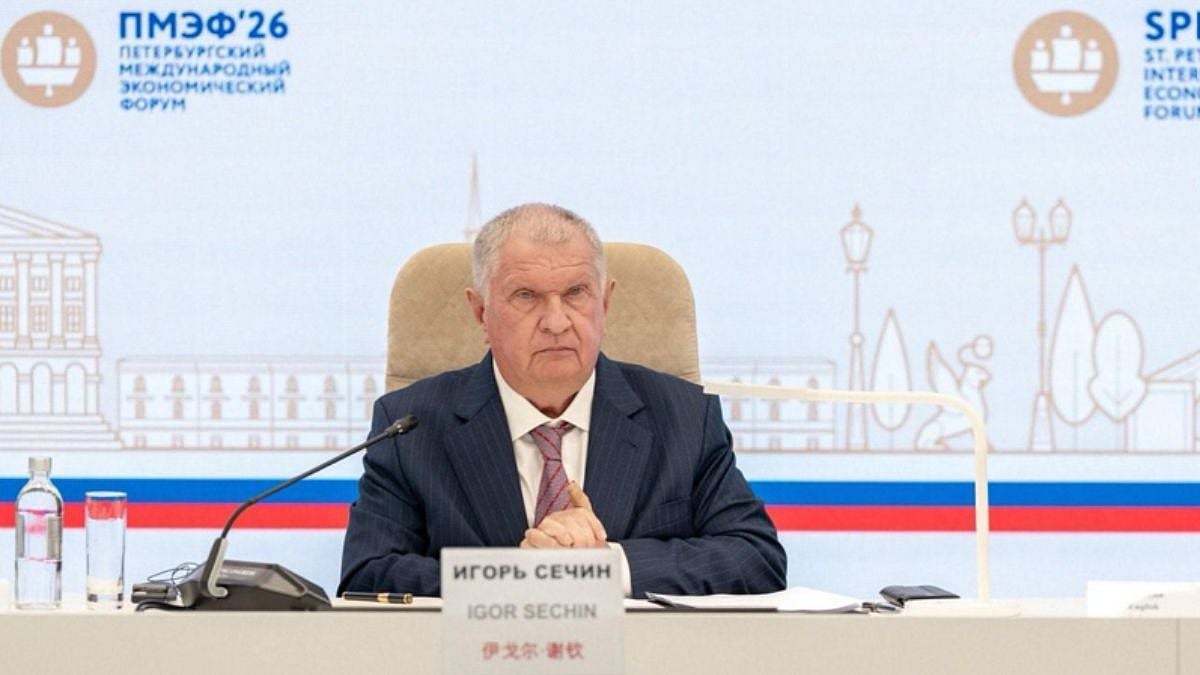
For many decades, the development of the global oil market has been shaped by the United States, Europe, and China. In the years ahead, however, the center of demand growth is expected to shift increasingly toward India. Along with its new economic weight, the country is also acquiring new risks: any shocks in energy markets, conflicts in key oil-producing regions, or disruptions in international trade will have an ever greater impact on the Indian economy. Can India effectively shield itself from external shocks? It is through this lens that the conclusions presented by Rosneft Oil Company CEO Igor Sechin at the St. Petersburg International Economic Forum are particularly interesting.
Opening the Energy Panel at SPIEF-2026, Sechin drew a parallel between the development of the global economy and the ancient Greek myth of Pandora’s box, which brought suffering and misfortune to humankind. According to him, the so-called “rules-based order,” in which the “rules” were dictated by an unquestioned hegemon, has now completely collapsed. “Pandora’s box has been opened, and the troubles and calamities that flew out of it will not return. The key question is: what problems are still left at the bottom of the box? What else are we yet to face?” the Rosneft CEO said.
Vulnerabilities of the system
According to the International Energy Agency, India will account for about half of global oil demand growth over the next decade, Igor Sechin noted in his report, The Beginning of the End or the End of the Beginning: What Remains at the Bottom of Pandora’s Box? at SPIEF-2026. By 2035, the country’s oil consumption is expected to reach nearly 8 million barrels per day, an increase of 44%. For comparison, global demand over the same period is projected to rise by only 5%.
This dynamic reflects fundamental changes in the structure of the global economy. Population growth, urbanization, the development of transport systems, the expansion of industrial production, and rising living standards are creating sustained demand for energy resources. As a result, India is becoming one of the key participants in the global oil market, capable of influencing its long-term trends.
This factor becomes especially important amid growing instability, Igor Sechin believes. A vivid example is the fallout from the crisis around the Strait of Hormuz, through which a significant share of the world’s oil supplies passes. Events in the Middle East have demonstrated the vulnerability of the current international trade system and the need to build more resilient mechanisms of energy security.
Risks and challenges
At the same time, the Rosneft CEO drew attention to profound changes in the structure of the world economy. Technological, financial, and military corporations are now coming to the forefront, becoming the main beneficiaries of ongoing developments. The global economy is increasingly dependent on decisions made in the interests of these groups, while traditional mechanisms of international regulation are losing effectiveness. One consequence of these changes is the massive shift of capital from the real sector into the virtual one. The volume of fictitious capital has already exceeded $500 trillion, almost five times the size of global GDP.
Igor Sechin suggested that we are witnessing the formation of a new financial bubble around AI companies, which are attracting a disproportionately large share of global investment. At the same time, the expected productivity gains have so far not been confirmed by statistics. Meanwhile, the development of artificial intelligence is leading to a rapid increase in electricity consumption and requires massive investment in energy infrastructure. By 2035, global electricity demand is expected to rise by almost 40%. At the same time, the unbalanced development of green energy has led to higher electricity prices: in the United States, by more than 30% over the past five years, and in Europe, by 35–45%.
The Rosneft CEO described this process as the global economy’s transition “from molecules to electrons,” which will be accompanied by growing demand for electricity, metals, and other resources. Against this backdrop, the role of countries capable of ensuring sustainable economic growth and generating real demand for energy resources becomes especially significant. India is one such country. Its importance is determined not only by the scale of its domestic market, but also by its growing contribution to global energy consumption.
Under these conditions, it will be the Indian market that largely determines the prospects for the oil industry, the investment decisions of energy companies, and the development of the global energy system.
